



Forming a Hong Kong limited company is a fast and simple process, but a quick incorporation does not guarantee a well-prepared business foundation. Founders who query how to incorporate a limited company in Hong Kong will discover that it goes beyond making an application. The company structure is crucial, the legalities of ownership are important, statutory record-keeping is essential, and a plan for compliance work will start after you register the company.
Many businessmen choose to get the essential choices ready in advance before they file, and then use a professional company for incorporation and ongoing business secretarial assistance. This reduces avoidable delays and gives your business a dependable administrative base from day one.
Why choose a Hong Kong limited company?
A private limited company in Hong Kong is a separate legal entity from its owners. This means the company can enter contracts, hold assets, open a business bank account and continue operating even when shareholders change. In most cases, shareholders’ liability is limited to the amount unpaid on their shares.
This structure is often suitable for startups, trading businesses, consultants, online businesses and overseas owners establishing a Hong Kong presence. It can also offer greater credibility with suppliers, customers and financial institutions than operating as an individual.
However, limited status comes with ongoing responsibilities. The company must maintain records, meet filing deadlines, keep proper accounting information and notify the relevant authorities about certain changes. Therefore, incorporation must not be viewed as a one-shot compliance event, but rather as the beginning of a working relationship with your compliance issues.
It is worth comparing Hong Kong company structures before making a decision on incorporation to see which is the optimal structure for your ownership, liability and long-term business objectives.
How to register a limited company in Hong Kong: key decisions first
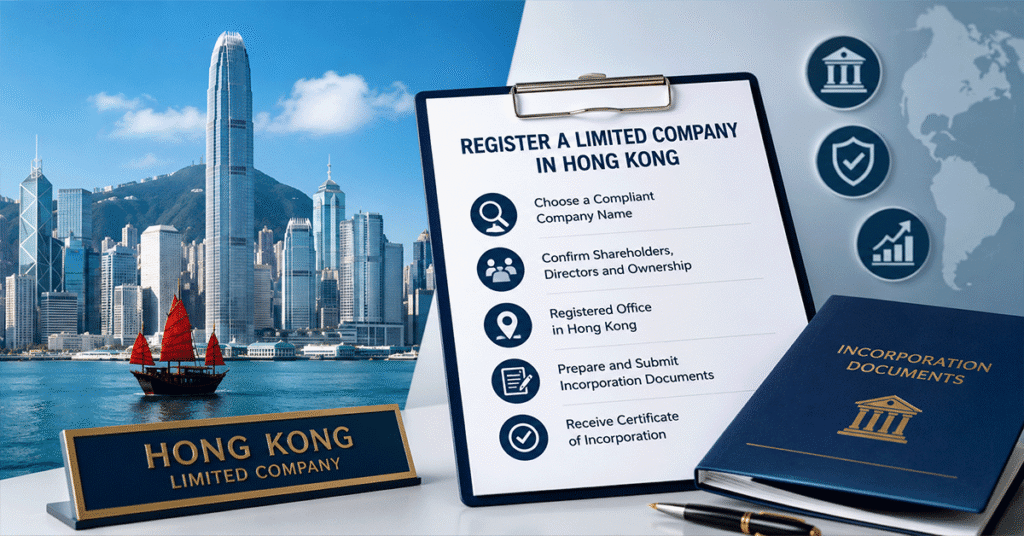
Before filling out the registration application, determine who will own and operate the company and the name and address of the company. Having clear answers at this stage will make filing easy.
Choose a compliant company name
Your company may have an English name, a Chinese name, or both. An English name must end with “Limited”, while a Chinese name must end with the Chinese equivalent. English and Chinese words cannot be mixed to form a company name.
The proposed name should not be an existing company name, and must not be misleading, offensive or imply a regulated activity which the business is not permitted to carry out. Some words may require prior approval. A name search should be completed before documents are submitted, particularly if your chosen name is central to your brand.
Confirm shareholders, directors and ownership
A Hong Kong private limited company can have one or more shareholders. Individuals and corporate entities may hold shares, and shareholders do not need to be Hong Kong residents. Many entrepreneurs ask whether foreigners can register a company in Hong Kong. Since shareholders and directors are not generally required to be Hong Kong residents, overseas founders can establish a private limited company in Hong Kong while meeting the applicable legal requirements.
The company must have at least one director who is a natural person. Directors can live outside Hong Kong, but they are responsible for the company’s management and statutory duties. It is worth agreeing on decision-making authority early, especially where there are multiple founders or overseas investors.
You will also need to identify the people who ultimately control the company. Accurate ownership information is essential for incorporation checks, banking arrangements and the company’s internal statutory records.
Appoint a company secretary and registered office
Every Hong Kong limited company must appoint a company secretary. If the secretary is an individual, they must ordinarily reside in Hong Kong. If it is a corporate service provider, it must have a registered office or place of business in Hong Kong and meet the applicable licensing requirements.
The company also needs a registered office address in Hong Kong. This is the official address for government correspondence and statutory documents. It should be a reliable address that is monitored consistently, rather than an address selected only for convenience.
If a director is the only director, they are not allowed to serve as the company’s director and company secretary. This is why many founders prefer an external company secretary provider; it helps to maintain the role independently and helps in managing the official notices and filing days.
Prepare the information and documents

The incorporation application requires accurate details, not lengthy paperwork. For individual shareholders and directors, the usual requirements include identity documents and proof of residential address. Corporate shareholders will need their formation and ownership documents.
Additional information that should be included is the proposed company name, business activities, the share structure, director and shareholder information, registered office address, and company secretary information. The company will require articles of association which will outline the internal rules of the company including decisions, directors and shares.
For a straightforward private company, a common starting point is one issued share with a nominal value in Hong Kong dollars. There is no fixed minimum share capital for a private company, but the share structure should suit your plans. Changing it later is possible, though it creates additional administration.
Where owners, directors or source-of-funds arrangements are complex, expect further due diligence questions. This is normal. Giving clear, consistent information up front helps in the smooth processing of your application.
Submit the incorporation application
A limited company is registered with the Companies Registry. The application generally includes the incorporation form, articles of association and prescribed fees. Once accepted, the company receives a Certificate of Incorporation and Business Registration Certificate.
Applications can be made electronically or in paper form. Online company registration Hong Kong is generally the faster option, provided all information is complete, and the chosen company name is available. A professional formation provider can prepare and submit the documents on your behalf, checking that director, shareholder, secretary and address details are correctly recorded.
Formation timing depends on the filing method and the complexity of the case. Simple applications can often be processed promptly, while unusual ownership structures, name issues or incomplete identification documents may extend the timetable. If you have a launch date, lease signing or customer contract pending, allow time for these practical variables.
Set up the records the company must maintain
After incorporation, your new company needs more than certificates. It must maintain statutory registers and corporate records. It includes registers of members, directors and company secretaries. It should also maintain a Significant Controllers Register at its registered office or any other place permitted.
It records individuals or legal entities with significant control over the company and must be kept accurate. The company also needs a designated representative who can assist authorised officers when required.
When it comes to record keeping, it can save time if done right from the beginning. Maintain copies of incorporation papers, share certificates, board resolutions, contracts, invoices, bank statements and letters regarding modifications to the company. They provide an aid to good financial management and to compliance with statutory requirements.
Open a bank account and organise your finances
Incorporation does not guarantee a business bank account. Banks and payment institutions will conduct their own due diligence and may require a business plan, anticipated transaction volume, contact information for suppliers & customers, contracts, and proof of source of funds or wealth.
Create a summary of the company and its operations, the exchanges it trades on, and its customers and how funds will flow in and out of the account. A well-organised application is more persuasive than a vague description of plans.
Keep all receipts and payout documents in the company account and have a regular bookkeeping process in place. Records which are not kept until a deadline is near often cause stress, increased cash flow visibility issues, and increased costs.
Understand the work that continues after registration
A Hong Kong limited company has recurring responsibilities. A private company generally files an annual return within 42 days after its incorporation anniversary. Business registration must be kept valid, and changes to company particulars, such as directors, shareholders, registered office or share capital, may need to be recorded and filed within prescribed time limits.
The company must also maintain proper accounting records, prepare financial information and meet its tax filing responsibilities. The exact workload depends on whether the business is active, where it earns income, the number of transactions and the complexity of its operations.
This is where a full-service provider can make a material difference. Gee Kay Systems & Accounting Limited supports businesses beyond incorporation, combining company secretarial administration, bookkeeping, tax support, financial reporting and ongoing compliance coordination. Having one point of contact helps founders avoid the gaps that can occur when formation, records and finance are handled separately.
Get the structure right before you start trading
The best time to resolve ownership arrangements, record-keeping processes and filing responsibilities is before the first invoice is issued. Hong Kong new business registration isn’t a simple process of paperwork.
If you register the company, you will have a legal instrument to grow your business; while keeping the company up and running, you will have enough confidence to use it.
If you intend to engage overseas shareholders, have multiple founders, engage in regulated activities or make a substantial investment, please consult on an ad hoc basis before filing. Some planning at the beginning can help to maintain that Hong Kong company organization, credibility and readiness for all those wonderful opportunities you are working towards.
FAQs
1. What is required to register a limited company in Hong Kong?
You will require a company name, at least one shareholder, and a company secretary. Even a registered office address and the necessary incorporation documents.
2. Why do I need a company secretary for a Hong Kong limited company?
A company secretary assists with the maintenance of statutory records, compliance filing, and the continuing corporate governance duties.
3. What documents are needed for a Hong Kong limited company registration?
These are typically things required for identification, proof of address, company information, articles of association, and shareholder and director information.
4. What should I do after my Hong Kong limited company is incorporated?
Keep statutory records, open a business bank account, set up bookkeeping, and keep up to date with annual returns and tax requirements.