



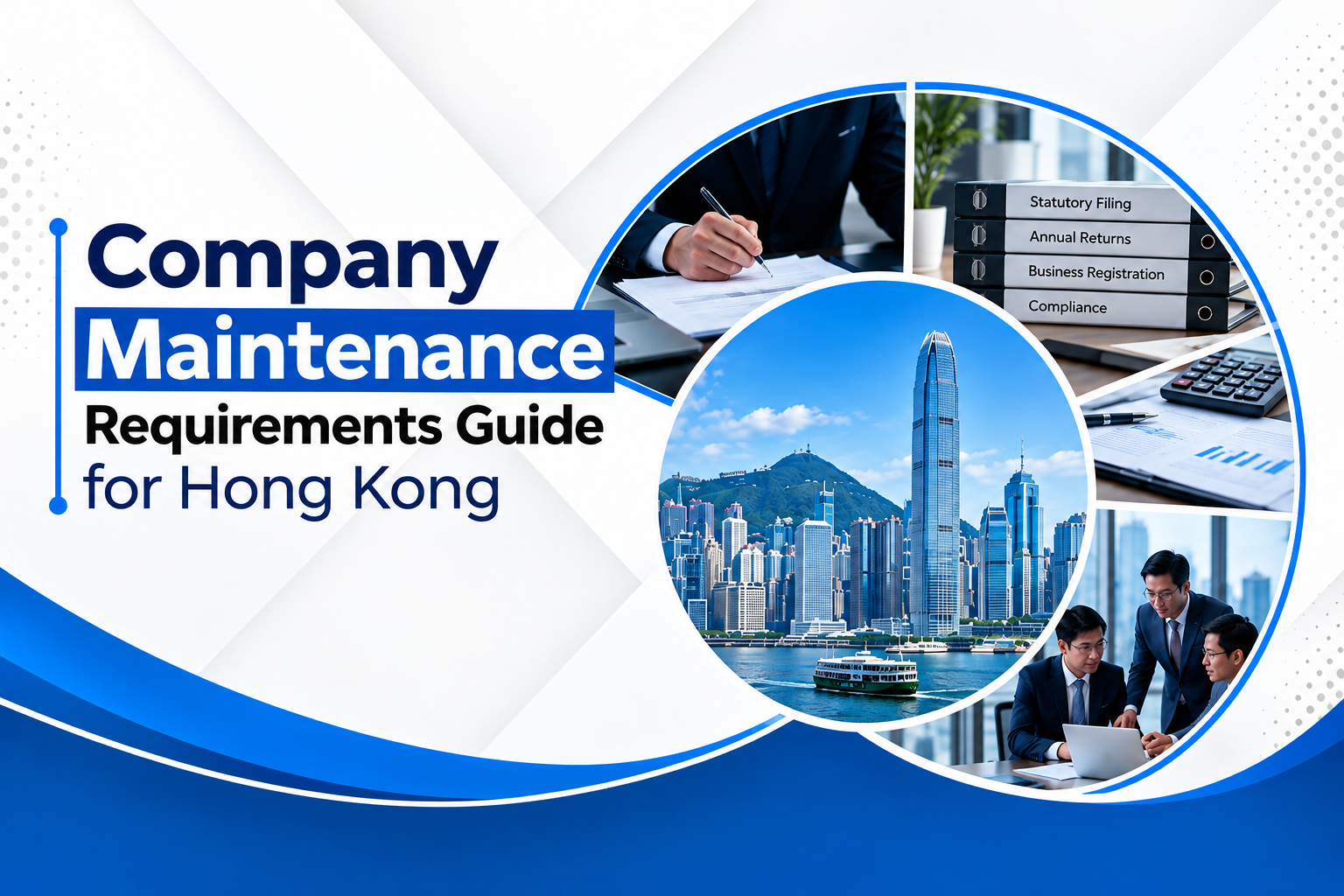
A Hong Kong company can be incorporated quickly. But keeping it in good standing requires consistent attention long after registration. This company maintenance requirements outlines the essential ongoing duties the company needs to undertake, why timing is important and where professional advice can minimise unnecessary risk.
For many growing businesses, the challenge is not one complex form. It is the accumulation of annual filings, company records, tax correspondence and internal financial information, all of which need to be handled accurately while the business continues to trade. A practical maintenance process gives directors confidence that statutory responsibilities are being managed without taking focus away from customers, staff and growth.
What company maintenance means in practice
Company maintenance is the ongoing administration required to keep a company legally active, properly documented and ready to meet its reporting responsibilities. It covers corporate secretarial work, business registration, record keeping, financial reporting and tax compliance.
The exact workload depends on the company’s structure and activity. A newly formed trading company with employees, suppliers and regular sales will have more accounting activity than a holding company with limited transactions. Both still require proper statutory records, a registered office, a company secretary, and regular company filings, though.
The best thing is to consider compliance as a business calendar and not a once-a-year chore. If records are updated throughout the year, deadlines are manageable and reliable financial information can be used to inform management decisions.
Core company maintenance requirements guide
Maintain a registered office and company secretary
Every Hong Kong company must maintain a registered office address in Hong Kong. This is the official address for government correspondence and statutory notices, so post received there should be reviewed promptly and retained where relevant.
A company must also have a company secretary. Where the secretary is an individual, that person must ordinarily reside in Hong Kong. Where the secretary is a corporate service provider, it must have an appropriate local presence. A sole director cannot also act as the company secretary.
This role is not simply administrative. The company secretary keeps the statutory records, prepares and files all forms, tracks corporate changes, and assists the company in complying with filing requirements.
Keep statutory registers accurate
Companies must keep certain registers and records up to date. These usually contain the information of directors, shareholders, company secretaries, and share allotments or transfers. Amendments to company details may have to be made within a certain timeframe and not at the next annual filing.
A filing requirement can occur, for instance, when directors are appointed and when directors resign, when the company changes its registered office address, when it issues new shares, and when it updates its secretary. If these updates are postponed for later, it may be difficult to keep public perception consistent with the company’s actual stance.
The Hong Kong companies have to keep a Significant Controllers Register as well. This is not normally subject to public inspection. Buit it must be stored in the correct location and be made available for inspection by authorized persons as required.
File the annual return on time
The company’s annual return is required to be filed with the registrar by a private company within 42 days of the anniversary of the date of incorporation. This filing confirms key company particulars, including information about directors, shareholders, and the company secretary.
The annual return is a common source of late fees because the deadline can be overlooked, particularly where founders assume that filing is tied to their financial year end. It is not. This is based on the incorporation anniversary.
Make reminders far in advance of the deadline and always keep in mind that any changes in the company during the year have been documented. This is because it becomes a confirmation exercise and not a last-minute information hunt.
Renew the business registration certificate.
Business registration must remain valid for a company to operate lawfully. Certificates may be issued for one year or, where available and selected, a longer period. Renewal should be monitored carefully, especially if the company uses a registered office service and does not receive government post directly.
A valid business registration certificate is often needed when dealing with banks, counterparties, landlords, and service providers. Allowing it to lapse can create operational inconvenience as well as compliance concerns.
Keep accounting records for at least seven years
Proper accounting records are the foundation of reliable company maintenance. Records should be adequate to explain the transactions, to provide a picture of the company’s financial situation, and to permit the preparation of financial statements and computations of taxes in a proper manner.
In real-world terms, this leaves you with bank statements, receipts, sales and purchase data, contracts, and payroll records so you can keep track of your expenses and sales. These records need to be retained for minimum of 7 years by Hong Kong businesses.
Waiting until year end to organise documents can be costly. Missing invoices, unexplained bank transactions and incomplete expense evidence may delay financial reporting and make it harder to substantiate tax positions. Regular bookkeeping, whether handled internally or outsourced, creates a far stronger control environment.
Prepare financial statements and meet tax obligations
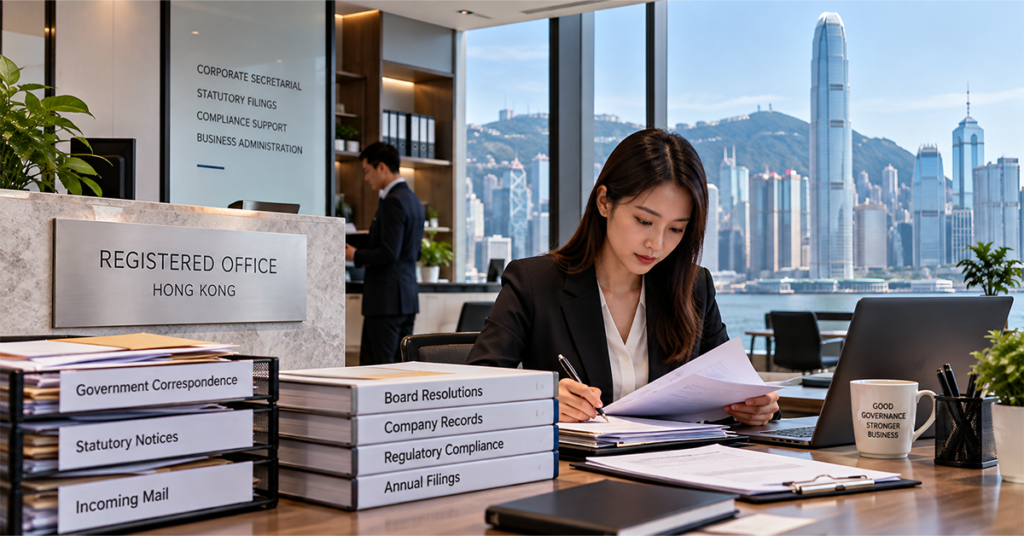
A company’s financial year should be planned rather than allowed to drift. Timely financial statements help directors understand profitability, cash flow, liabilities and working capital requirements. They also provide the information needed to respond efficiently when a profits tax return is issued.
Profits tax returns are issued by the Inland Revenue Department according to its timetable. The standard filing period stated on the return is often short, although extensions may be available in appropriate circumstances. The company should not assume it has no filing responsibility simply because it has made little profit or has not traded actively.
The tax treatment of a business depends on its facts, including where income-producing activities are carried out, the nature of transactions and whether the company has assessable profits. This is an area where broad assumptions can be expensive. Clear records and timely professional advice are more dependable than attempting to apply a general rule to every business.
Build a maintenance calendar around your key dates
The simplest way to stay on top of requirements is to maintain an annual compliance calendar that brings together the company’s key deadlines and recurring obligations. It should include the incorporation anniversary, annual return deadline, business registration renewal date, financial year-end, expected tax timetable, and any internal deadlines for completing bookkeeping.
It should also include event-driven obligations. A director appointment, share transfer or registered office change may require action before the next scheduled compliance date. Keeping a record of decisions as they happen makes it easier to identify these triggers.
If there are multiple shareholders or directors abroad, make sure you make an agreement between all of them regarding who is going to approve and give documents. These delays rarely occur with challenging rules but rather when unanswered e-mails, unsigned resolutions, or records are held between various locations.
Common maintenance gaps that create unnecessary pressure
Common issues are simple ones such as late filing of annual returns, bookkeeping done at the last minute, company changes not reported in time, and statutory registers not in line with reality. But these gaps can impact banking arrangements, investor due diligence, transaction readiness, and the trust of business partners.
The other regular problem is the assumption that a company that is dormant or low-activity is maintenance-free. If that’s the case, the company has a lighter accounting burden, but this doesn’t mean they forfeit their corporate responsibilities. Its registered details, annual filings,, and business registration status still need attention.
In addition, there is a balance between handling everything in-house and having someone else do it. An owner can hold documents and approvals related to the day-to-day running of the business in-house and also can outsource the statutory documents, company secretarial documents, bookkeeping monitoring, and bookkeeping deadlines to a specialist day-to-day service provider. It will depend on the number of transactions, the ability of the company to handle its own transactions, and the risk that the directors are willing to take.
When outsourced support makes commercial sense
Outsourced maintenance is especially beneficial for businesses that don’t have an in-house financial or compliance team, for those whose directors are not in Hong Kong, or for rapidly expanding businesses. One provider can provide combined company secretarial services, bookkeeping, financial reporting, and tax assistance to prevent the duplication of requests.
The value is not only in submitting forms. It is in having a consistent process, clear ownership of deadlines, and records that are kept in a usable condition throughout the year. GEEKAYSYS supports companies with this ongoing operational discipline, allowing directors to spend less time tracking statutory tasks and more time running the business.
Keeping a company well-maintained is easier to manage, easier to review, and better prepared for change. Begin on a calendar, stay up to date, and don’t wait until a deadline is an issue to get help.
FAQs
1. What are the main company maintenance requirements in Hong Kong?
Requirements include maintaining company records, filing of annual returns, renewal of business registration, accounting records, and compliance with tax obligations.
2. How often does a Hong Kong company need to file an annual return?
The private company’s annual return is usually due on the anniversary of the company’s incorporation, within 42 days.
3. How long should Hong Kong companies keep accounting records?
The accounting records for Hong Kong businesses should normally be kept for a period of seven years.
4. What should an annual compliance calendar include?
It should include annual return deadlines, incorporation anniversaries, business registration renewals, financial year-end dates, tax deadlines, and internal bookkeeping deadlines.
5. Are there any maintenance requirements for dormant companies?
Yes. A low-activity or dormant company could have less accounting work, but still needs to attend to its corporate records and annual filing/business registration.