




A missed statutory date is not urgent until a penalty notice, filing backlog or banking query comes. Those risks should be converted to an annual compliance calendar for the business owner in Hong Kong to follow and each item should be assigned a specific owner or owners, as well as ample time to complete the necessary records properly.
For founders and growing SMEs, the challenge is not simply knowing that returns must be filed. Different obligations follow different dates: some are tied to the company’s incorporation anniversary, others to its financial year-end, tax correspondence or Business Registration expiry date. A practical calendar gives your business control without drawing attention away from customers, operations and growth.
What an annual compliance calendar should cover
Your calendar should be built around the company’s own key dates rather than a generic list copied from another business. Start with the incorporation date, the Business Registration Certificate expiry date, financial year-end, tax filing correspondence, payroll cycle and the dates directors expect management accounts.
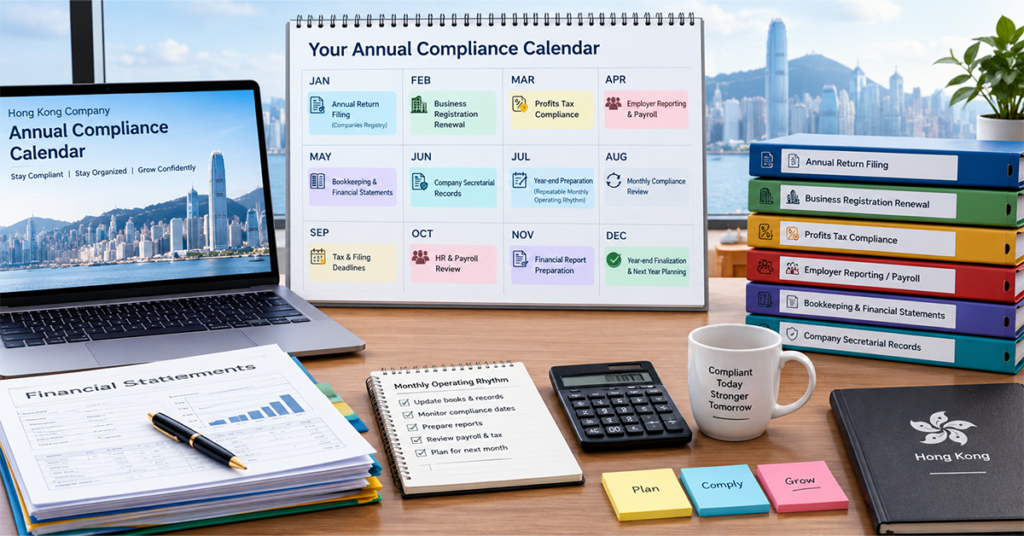
For most Hong Kong private companies, the calendar should cover annual return filing, Business Registration renewal, profits tax compliance, employer reporting, bookkeeping, financial statement preparation and company secretarial record maintenance. If the company has employees, shareholders based overseas, group entities or a higher volume of transactions, allow more lead time for gathering information and resolving questions.
The goal is not to create a long checklist for its own sake. It is to establish a repeatable operating rhythm: records are kept current every month, year-end work is prepared before deadlines approach, and statutory filings are submitted from complete and reviewed information.
Key dates for a Hong Kong company
Annual Return: within 42 days of the anniversary date
A local private company generally needs to deliver its Annual Return, commonly filed on Form NAR1, within 42 days after its incorporation anniversary date. For businesses preparing for this deadline, an annual return filing guide can provide a useful reference for the filing process and required company information.
This filing validates the information already on the public company register, including its registered office, directors, company secretary, shareholders and share capital.
The register may need to be updated if there are any changes to these details and it is important not to assume that nothing has changed between adding it to the register and the anniversary. Build in a check six to eight weeks before the due date. Confirm names, identity details, addresses, appointments, resignations and share movements against the company’s current records.
Late filing can lead to escalating fees. More importantly, an inaccurate filing can create avoidable difficulties during financing, due diligence, account opening or a future sale of the business.
Business Registration renewal: check the certificate expiry date
Business Registration is renewed on the basis of a period of one or three years as indicated on the certificate. The incorporation date doesn’t always coincide with the renewal date, so it’s worth having its own reminder on the calendar.
Depending on the company’s position, the renewal process will vary according to the certificate issued. Always have a copy of the current certificate on hand for your corporate records and reminders early for the certificate expiration. If your business address or activity has changed, be sure to take the time to make sure that internal records and required notifications have been made, instead of renewing as an administrative payment.
Profits tax: plan from the financial year-end
Profits tax deadlines are driven by the return issued by the Inland Revenue Department, not by one universal annual date. The time allowed is stated on the return, and a tax representative may be able to apply for an extension under the relevant arrangements. The exact timeline can depend on the company’s accounting date and circumstances.
That is why financial year-end should be the main planning point in an annual compliance calendar Hong Kong businesses can use to organize their tax and reporting responsibilities. At the end of the year, close books, reconcile bank statements, review receivables/payables, gather supporting documentation, and complete financial statements necessary for tax filing.
A quiet year is no time to sit around and think nothing of it. A company with no trading activity may still have filing responsibilities. Likewise, a company that has traded overseas should not presume its income is outside the Hong Kong tax net. The correct treatment depends on the facts, the nature of the income and where the relevant profit-producing activities took place.
Employer’s Return: usually issued in April
Employers should expect the annual Employer’s Return to be issued around the first working day of April. It is generally due within one month of issue, unless an extension has been granted. This return reports remuneration information for employees and certain other relevant persons.
Prepare for it before April by checking payroll records, salaries, commissions, benefits, allowances and the details of staff who joined or left. Where staff move in or out of Hong Kong, or where directors receive remuneration, the position may need closer review. It is much easier to report accurate payroll information throughout the year than to try and reconstruct it at filing time.
Significant Controllers Register: maintain it continuously
Applicable companies must maintain a Significant Controllers Register. And update it when any relevant changes are made. This is not a yearly event that can be put to the back of the mind until the end of the year. Your calendar should nevertheless include periodic checks to ensure the register is current and that the designated representative arrangement remains appropriate.
This is a useful example of why compliance cannot be reduced to annual deadlines alone. Some obligations are event-driven. A change in ownership, control, director details, registered office or company secretary may need prompt action at the time of change.
Turn deadlines into a workable monthly routine
The strongest annual calendar is supported by regular bookkeeping. When invoices, bank transactions, expense claims and payroll entries are processed every month, year-end reporting becomes an organised review rather than a recovery exercise.
A sensible routine is to reconcile bank accounts monthly, chase missing sales and purchase documents, review aged receivables, record director transactions correctly and retain evidence for significant payments. Hong Kong businesses should generally keep sufficient records of income and expenditure for at least seven years. Digital storage can make this more manageable, provided records are complete, legible and easy to retrieve.
Quarterly management accounts can also add real value. They help directors see cash flow pressures, margin changes and tax provisions early. For a new business with limited activity, quarterly work may be enough. For an established company with frequent transactions, monthly reporting will usually provide better control.
A sample planning cycle for founders
Instead of each deadline being an emergency, plan ahead for the year. When the financial year begins, verify the essential company data, reporting schedule, and who will be supplying documents. During each month, keep bookkeeping up to date and review cash movements. In the months before financial year-end, identify outstanding invoices, stock issues, intercompany balances and supporting documents.
After year-end, prioritise the preparation of financial records and tax information. Six to eight weeks before the incorporation anniversary, review the details needed for the Annual Return. Before April, validate payroll data for the Employer’s Return. Throughout the year, deal with corporate changes as they happen rather than allowing them to accumulate.
The exact sequence will vary. A holding company with few transactions may need a lighter routine, while a trading business with employees, multiple currencies or overseas suppliers will benefit from closer monthly support. The principle remains the same: preparation time should be scheduled before the filing date, not borrowed from it.
Common calendar mistakes that create unnecessary risk
A common mistake is using only one reminder of the deadline. A reminder on the due date won’t give time to find a missing bank statement, clear up a change in shareholders or fix a payroll mistake. Create at least 2 alerts: preparation and final filing.
Another is assuming an external service provider holds every document needed. Company secretarial records, bookkeeping records, payroll information and tax correspondence often sit with different people. Determine who will be responsible for each item and where it will be kept. Getting the documents signed off on and having a single point of contact can avoid any delay.
Finally, do not neglect a change that is not important for the business. Consequences for compliance may be broader, such as relocating the office, hiring a new director or altering the nature of operations. Raise the change early and obtain advice before documents are signed or records are updated informally.
When outsourced support makes sense
Outsourcing may be helpful where the founders are expanding the business without an in-house finance and company secretarial team. It helps to ensure continuity in the event of staff changes, ensures that records are in sync with other obligations and helps to give directors a clearer picture of the next obligation.
GEEKAYSYS can support businesses with company secretarial maintenance, bookkeeping, tax preparation and financial reporting as coordinated ongoing services. The benefit is not just submitting documents on time. It is having a dependable process that keeps the company’s records ready for decisions, opportunities and regulatory requests.
A calendar is most valuable when it becomes part of how the business operates. Put the dates in place, assign ownership, maintain records as you go and give yourself time to act before compliance becomes urgent.
FAQs
- What should an annual compliance calendar for a Hong Kong company include?
It should cover annual return filing, business registration renewal, profits tax, employer’s Return, bookkeeping, and company secretarial requirements. - When is a Hong Kong company’s annual return due?
A local private company submits its annual return within 42 days after its incorporation date.
- Is the business registration renewal date same as the incorporation anniversary?
No. Registration of business will follow the validity period on the certificate and should be set as a calendar reminder.
- Why is it important to prepare for compliance deadlines early?
Preparing in advance allows businesses enough time to collect missing documents and address discrepancies and complete filing documents properly before the deadline.
- How can businesses manage Hong Kong compliance throughout the year?
Maintain monthly bookkeeping, schedule preparation reminders before major deadlines and review company information regularly instead of waiting until filing dates.