



The arrival of a profits tax return from the Inland Revenue Department may seem like a disruption when you are busy with your sales, suppliers, and your customers. A well-managed SME tax filing checklist ensures tax filing is a routine process, not a hurried one at the last minute when you’re chasing invoices and financial statements.
The quality of the filing is more related to the quality of the financial records the SME maintains throughout the year, and not how quickly a form can be completed. Proper preparation allows you to make sure you understand where you are, what is being reported, and to be able to answer with confidence if they request more information. If you are an SME in Hong Kong, this Profits Tax Return guide will help you understand what’s involved in filing a Profits Tax Return, gather the necessary documents, optimise your deductions to get the best tax refund, and ensure that the deadlines are met.
SME Tax Filing Checklist: What to Prepare
Get ready as early as the end of your fiscal year. Waiting until it arrives may lead to stress, particularly when payments are made via multiple bank accounts, payment platforms, or currencies.
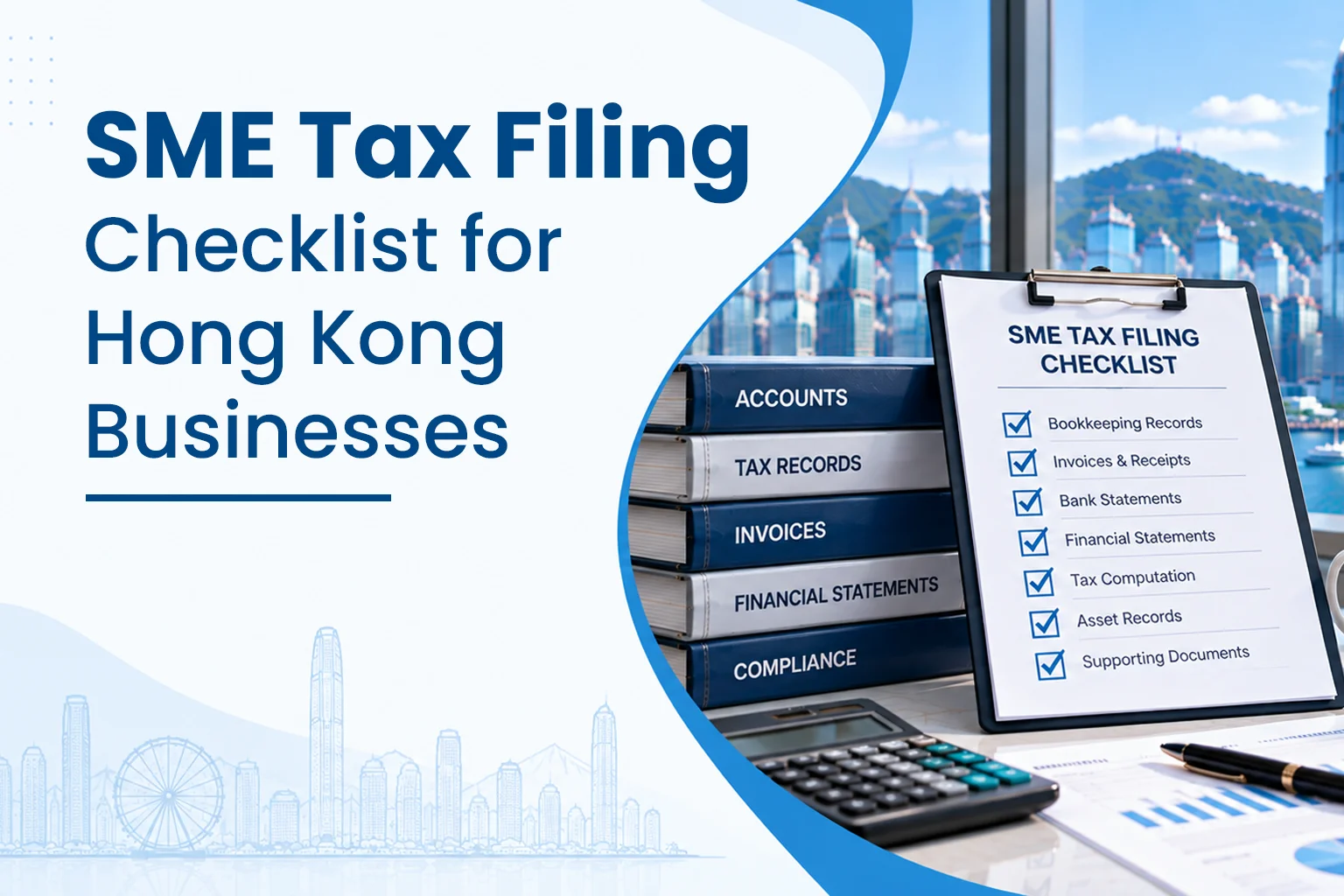
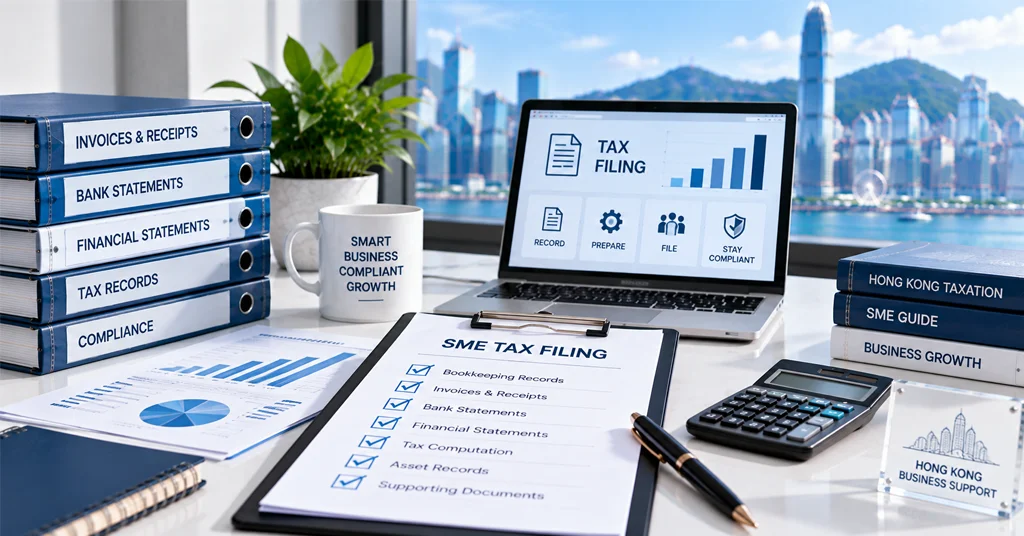
Keep in mind that these are some of the simple records required in a checklist.
- Include all transactions made using a bookkeeping system during the accounting period, including sales, purchases, expenses, payroll transactions, and journal adjustments.
- Bank & credit card statements, payment gateway statements and loan statements.
- Sales invoices, supplier bills, receipts, contracts, and other documents that relate to material transactions.
- Profit and loss account and statement of financial position for the period.
- The tax computation is clearly provided, and the adjustments made in the computation of accounting profit to arrive at the taxable profit or loss are suitably explained.
- Information on assets bought, sold or used in the business such as: equipment, vehicles, computer hardware.
- Details regarding related party transactions, foreign income, commissions, management fees and payments requiring special tax attention.
This is not just a business of administration. The figure on the return is based on the evidence in each item. Incomplete records can make it take longer for the business to reconstruct transactions and can make it more difficult to make a case for deductions.
Confirm the Correct Filing Period and Deadline
Normally, a Hong Kong company will submit its profits tax return for the accounting period referred to in the tax return. The date on which the return is issued is important, because returns are normally due within one month except when allowed to be extended by an approved extension.
Last year’s timetable does not necessarily apply this year. Documents required and the time available can be impacted by changes to the company’s financial year-end, the incorporation of a business, a dormant period, or a first return.
Create an internal filing schedule, working backward from the filing date. Provide an opportunity for bookkeeping and reconciling accounts, preparing financial statements, reviewing the tax consequences and giving time for Directors to review the information. This sequence is much less dangerous than thinking that the submission date is the time to start working.
If your business has a tax representative, plan the extension arrangement early. While an extension can be a helpful time, it is not an excuse to skip a resolution of records. The clearer the records, the more efficiently the return will be prepared.
Keep Bookkeeping Separate From Tax Decisions
Bookkeeping is strictly about what has transpired during the business. Tax preparation takes into account these actions and how they must be reported for profits tax. They are closely related, but not the same.
For instance, a cost that is included in the accounts may not be tax-deductible. Treatment may differ depending on the circumstances of the occurrence (assessable profit or not); whether it is capital or revenue in nature; and whether supporting documentation is provided for a genuine business purpose.
These are payments for entertainment, private or mixed-use spending, staff benefits and provisions, depreciation, donations, legal costs and payments to connected parties. Capital expenditure is important since the accounting and possible tax allowances could be different.
This review is easier if there’s a disciplined chart of accounts in place. Don’t lump all payments into general categories like “general expenses”; make sure to document costs by explaining what they are going towards. Clear descriptions save time later and provide management with a better view of spending.
Reconcile Before You Finalise
Many filing issues are averted in the reconciliation process. All bank balances, loan balances, Customer Receivables and Supplier Payables should be confirmed with supporting records. It could indicate that invoices have been missed, entries double-counted, and personal expenses paid with business funds or income unreported.
Be sure to check out the director accounts. Whether it’s a reimbursement, loan, payment made to the company, or money left in the company, funds transferring between a director and the company should be clearly documented. Entries that are too general can cause problems when preparing financial statements and tax returns.
Review Income With a Hong Kong Focus
The Hong Kong profits tax has a general application to profits from a trade, profession or business conducted in or from Hong Kong. The presence of a client does not determine the tax position for companies that have international customers, suppliers or teams.
The type of income-generating activities is important. Think about the location of discussions and agreements regarding contracts, the location of services rendered, the location of and the manner in which important business decisions were reached, and the source of business profits. It can be different in different business models, such as trading, consultancy, software services and online sales.
Income is not classified as offshore simply because it was received from overseas or an invoice issued to an overseas customer, but not licensed by the FSA. The position that may be supported must include facts, records and a coherent explanation of the operation of the business. For overseas income, maintain contracts, correspondence, delivery and operating documents from the beginning.
Check Deductions Before Claiming Them
One way to do this is to ask yourself two questions when making a significant expense: was this expense made for business and can the company prove it? If you cannot certainly answer the question, ask for clarification before returning.
Don’t throw out original receipts or invoices unless possible, particularly for large purchases. Documents ought to contain the following information: supplier details, date of expense, description of the expense, and cost of the expense. A card statement alone may be adequate evidence of payment but not enough to offer any explanation for the payment as a business expense.
Keep the original contract and the invoice for the ongoing costs such as rent, software, professional costs, and marketing costs. This will help define commercial use and facilitate future filing periods.
Do Not Overlook Tax Payments and Losses
Determine whether there has been a payment of provisional profit tax and whether the current-year position is significantly different from the previous estimate. A business can apply for a provisional tax holdover if there is a decline in profits, provided of course the conditions and timing are met.
Even in the event the enterprise has lost money, it is still necessary to prepare complete records and file properly. The amount of tax losses may be carried forward against future assessable profits; however, the amount must be correctly calculated and substantiated by the underlying accounts. Don’t be lax in record-keeping a loss year.
Maintain Records After Submission
Submitting the return is not the end of the compliance chore. In general, the bookkeeping requirements are to keep books and accounts for at least seven years for Hong Kong businesses. Store the digital copies in a well-organised system and have them easily accessible whenever required by a director, finance team member or adviser.
A sensible filing structure will break down the sales, purchases, banking, payroll, contracts, fixed assets and tax correspondence into financial year files. In the case of businesses that are using cloud accounting software, establish a regular practice of reconciling and uploading documents instead of doing it once a year.
This method will also make management decisions easier. Real-time data provides insights into margin trends, customer payment habits and spending in relation to business goals. Tax preparation does not strain finances. But it is a component of financial management.
When Outsourced Support Makes Sense
In the early stages, some founders may have simple books, which they can manage on their own. When there are more transactions, more cross-border transactions, more people making payments, the number of errors that need to be corrected can rapidly surpass the number of ongoing support.
Using an outsourced accounting and compliance service will ensure that records are kept up to date, financial information is prepared, tax filing requirements are coordinated, and directors have one point of contact. For businesses in Hong Kong that wish to have this work done consistently, GEE Kay Systems & Accounting Limited can be of assistance, allowing staff to concentrate on their businesses’ operations and growth.
The easiest good tax filing habit is this one: Consider each month to be a planning session for year-end. When records are kept current and business actions are taken and documented in real-time, your next tax return will be a business process you control, rather than a surprise!
FAQs
1. What is a profits tax return in Hong Kong?
A profits tax return is a tax return form sent by the Inland Revenue Department (IRD) to businesses to submit for assessment on the profits (or more broadly, losses).
2. What documents are required for a Hong Kong profits tax return?
The usual accounting documents are accounting records, bank statements, invoices and receipts, financial statements, and tax computation.
3. When is the due date for submission of profits tax returns in Hong Kong?
The ordinary deadline is 1 month from the date of issuance of the return; it may be extended or superseded by an alternative or another date as provided by any resulting extension of the deadline or an alternative deadline.
4. In Hong Kong, is everything that your business spends money on tax deductible?
No, any expenses that are not directly connected with the property are not deductible, and expenses must satisfy the tax requirements.
5. Do Hong Kong SMEs need to file a profits tax return if they make a loss?
Yes, a business must make a return even if it incurs a loss or doesn’t have any assessable income if the IRD requires a return to be completed.