




A Hong Kong company can often be incorporated quickly. The more consequential work begins before the filing of the application and includes selection of an ownership structure that will make sense, appointment of appropriate statutory roles, and establishment of a trusted record and filing process. Establishing a company in Hong Kong is not just a formality.
For founders, international operators and established SMEs, the practical aim is straightforward: create a company that is properly organised from day one, without allowing administration to consume time needed for customers, products and growth.
One of the first questions many founders ask is about the cost of setting up a company. Incorporation fees represent just a portion of the total cost; however, companies should also plan for company secretarial fees, registered office support, bookkeeping fees and other compliance costs.
Setting up a company in Hong Kong starts with the right structure
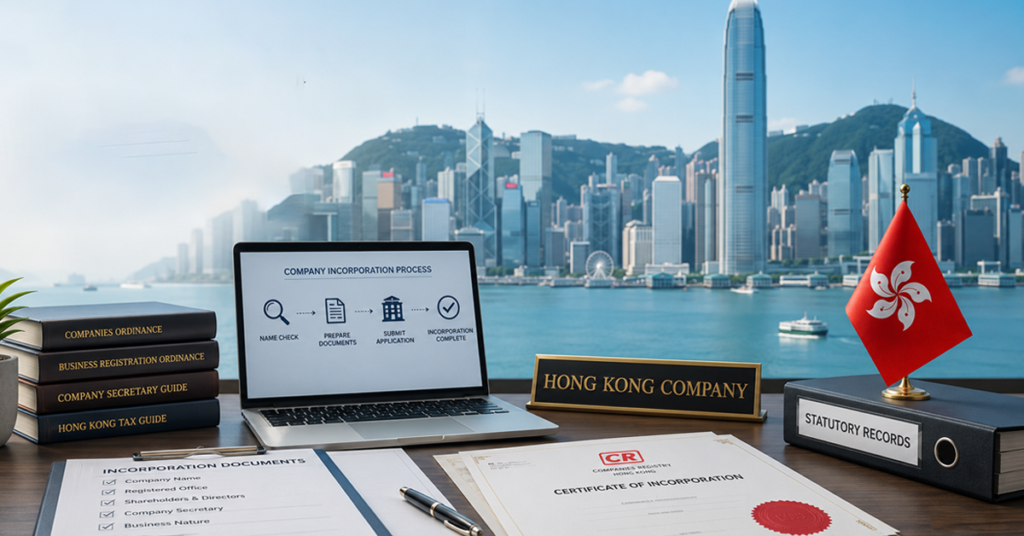
A private limited company is the preferred option for companies that wish to have a separate legal body, limited liability and a clearly defined trading structure, employing employees or attracting investors. It holds its assets and contracts are in its own name, and it has its own finances separate from its shareholders.
When choosing between a sole proprietorship or limited company Hong Kong structure, many entrepreneurs are interested in understanding which one provides the optimal combination of liability protection, flexibility and growth potential. A sole trader arrangement might work for your small business, but a private limited company offers more legal protection, business credibility, and growth opportunities.
Comparing Hong Kong company structures can help you determine which one is ideal for your business goals, ownership, and liability requirements before you make a final decision.
Also, decide who will own shares, who will act as director, and how key decisions will be made. A Hong Kong private company needs at least one director who is a natural person, at least one shareholder, a company secretary, and a registered office address in Hong Kong. The same individual may often be both director and shareholder, but a sole director cannot also serve as company secretary.
This is a useful point to pause rather than rush. A simple ownership arrangement may be ideal for a founder-led business, while a venture with several partners may need a shareholders’ agreement that addresses voting rights, funding obligations, share transfers and what happens if someone leaves. Incorporation documents establish the company, but they do not resolve every commercial disagreement later.
Company names also deserve more care than they sometimes receive. The proposed name must be available and should not be too close to an existing name. It should also suit the markets in which the business plans to operate. It is possible to change a name but will involve unnecessary work on bank records, contracts, invoices and customer communications.
Prepare the information before filing
Well-prepared applications tend to be more efficient than those that lack or are inconsistently detailed. This essential information typically includes the company name, registered office, share capital, shareholder and director information, company secretary information and a business description of the proposed activity.
It is also worth understanding the company formation fees involved before submitting an application. These may include government registration charges as well as professional service fees if you use an incorporation or company secretarial provider.”
When choosing a service provider, look for transparent pricing so you know exactly what is included in the incorporation package and any ongoing compliance services.
The stated share capital does not need to be complicated. Many companies begin with a modest amount, but the figure should reflect the intended ownership arrangement. If shares are held by more than one person or entity, document the number and class of shares clearly from the outset.
Identity and address evidence will also be required for relevant individuals and, where ownership is held through another entity, supporting corporate documents may be needed. International founders should allow time for verification requirements, especially where documents are issued overseas or ownership involves several layers. Trying to resolve these points after filing can slow down the process.
A registered office is more than a postal address. It is the official address for statutory correspondence and records. A professional company secretarial provider can supply this function and help ensure important notices are not missed or left unattended while directors are focused on operations.
Registration is only the first milestone
Once the company is incorporated and business registration is in place, many founders turn immediately to opening a business bank account. This is understandable, but banking decisions should be approached as a separate process. Financial institutions and payment providers will assess the nature of the business, expected transactions, ownership, source of funds, and connection to Hong Kong. Just because a company is incorporated does not mean that the account is approved.
Make a clear statement about your business model, who your customers and suppliers will be, how many transactions you’ll expect to make, any relevant contracts or invoices, and an easy-to-understand overview of how the business will be funded. The more congruous this information is with the incorporation record and website or sales materials, the easier it will be to answer follow-up questions.
For businesses that are involved in international trade or are paid in foreign currencies, it might be prudent to look for several different providers. The right choice will vary depending on the point of payment of the customer, the payment terms for suppliers, the volume of transactions, the currencies the business requires, and the type of support it wants. Speed matters, but so does having a payment arrangement that supports the way the company will actually trade.
Put financial records in place before transactions begin
A company should not wait until its first tax filing to organise its books. For the first expense, sale or transfer of money, the business requires an accurate record of what has happened and why. Maintain an organized system of related invoices, receipts, agreements, bank statements, payroll documentation and corresponding correspondence.
This is especially crucial in scenarios of directors paying early costs from their own coffers, or where funds are passed between related parties, or when a business is conducted across borders. These transactions can be entirely legitimate, but they need to be recorded correctly. A tidy record at the time is far easier to explain than a reconstruction many months later.
Choose an accounting process that matches the business’s size and activity. A very early-stage business may need regular bookkeeping and management reports rather than an in-house finance hire. A growing trading company may benefit from clearer supplier controls, accounts payable support and software that gives management a timely view of cash flow. The objective is not paperwork for its own sake. It is dependable financial information for decisions.
Using separate personal and company funds is one of the simplest disciplines a founder can adopt. Pay company costs from the company account where possible, record director funding clearly and avoid treating the company account as a personal wallet. This protects the quality of the accounts and reduces confusion when tax and statutory reporting deadlines approach.
Understand the ongoing compliance calendar
A Hong Kong company has continuing obligations after formation. These are typically the obligations of maintaining statutory registers, updating Company information when changes are made, renewing the Company’s registration when necessary, preparing annual returns and answering tax letters. There is also a requirement to keep a Significant Controllers Register, with a suitable designated representative where necessary.
The annual return is a common deadline to manage carefully. It is generally due within a defined period after the anniversary of incorporation, and late filing can lead to higher fees and unnecessary stress. Changes to directors, shareholders, share capital, the registered office or company secretary may also require prompt action. Do not assume these updates can wait until the next annual filing.
Tax obligations need the same forward planning. Hong Kong applies a territorial approach to profits tax, but whether profits are taxable depends on the facts of the business, including where profit-generating activities are carried out. Offshore treatment is not automatic simply because customers, suppliers or a bank account are outside Hong Kong. Keep evidence that reflects how the business earns its income and seek advice based on the actual operating model.
The first profits tax return is not usually issued immediately after incorporation, which can create a false sense that no preparation is needed. By the time it arrives, the company should already have complete books, supporting documents and properly maintained financial records. Good compliance is a routine, not a last-minute exercise.
Use specialist support as an operational function

Founders need not create an in-house company secretarial and finance team to manage a compliant company. Delegating such tasks can provide a single point of accountability for incorporation, statutory documents, accounting, tax assistance, and annual maintenance. It’s also a protocol for the company to follow when it changes direction, acquires new owners, brings in new employees, or expands into foreign markets. The incorporation process with professional Hong Kong company formation services can be streamlined and can ensure statutory and compliance matters are taken care of as the business expands.
The value of professional support is not limited to submitting forms. It is the ability to ask practical questions before a decision creates a problem: should a new shareholder be added now, how should director funding be recorded, what evidence should be retained for an overseas transaction, or which deadline applies after a change in the company structure?
Gee Kay Systems & Accounting Limited supports businesses that want this work handled with consistency, so management can keep attention on commercial priorities rather than statutory administration.
A company that begins with clear ownership, disciplined records and a managed compliance calendar is easier to operate when opportunities arrive. Those bases will be laid early, and the company can become a tool to serve the business, not another job that takes the founder’s time.
FAQs
1. What is required to set up a company in Hong Kong?
You will require a company name, at least one director, a shareholder, a company secretary, a registered office address, and the necessary incorporation documents.
2. How long does it take to set up a company in Hong Kong?
The registration process for most Hong Kong Companies can be completed in a few business days if all necessary documents and information are present.
3. Can a foreigner set up a company in Hong Kong?
Yes. Foreign persons and overseas companies may establish and run their company without having to be Hong Kong residents.
4. Do I need a company secretary for a Hong Kong company?
Yes. Every Hong Kong private limited company must appoint a qualified company secretary to help meet statutory compliance requirements.
5. What are the ongoing compliance requirements after company incorporation?
Business registration, keeping proper accounting records, registering statutory returns, renewing business registration, and tax filing are all things companies have to do annually.
6. Why is bookkeeping important for a newly incorporated Hong Kong company?
Good bookkeeping ensures financial records are kept in order, tax compliance is easier, cash flow is managed, and statutory reporting is simpler.