




When bookkeeping is in a spreadsheet, and the pile of receipts is in front of you, and one believer is overstretched and doing bookkeeping at the same time, the question is not “Should we improve the process?” The question is “How do we improve the process?” It’s whether outsourced bookkeeping is right for the way your business operates.
For founders and SME owners, this is rarely a theoretical finance debate. It affects cash visibility, filing deadlines, reporting quality and how much management time disappears into admin. The selection relies on the volume of your transactions, your own capacity, growth intentions and control requirements on a day-to-day basis.
Outsourced bookkeeping vs in house: what is the real difference?

In-house bookkeeping involves having someone work for your business to handle your bookkeeping. This can be an entire bookkeeper, an assistant bookkeeper on a part-time basis, or a larger team of accounts as the company expands. They operate in your business, know your processes, and are typically on hand to answer your daily questions.
Outsourced bookkeeping involves hiring a third party, or outside party, to do some of the bookkeeping for you. That can include the recording of transactions, bank reconciliations, accounts payable support, management reporting, tax-ready records, and the ongoing coordination of compliance.
That is not just the difference in the location of the work. It is the organization of skills, work, systems, and controls. In-house can provide intimacy to the business. Outsourcing can provide extra technical support and less operational burden. Neither is necessarily superior in all situations.
Cost is usually the first issue, but not the only one
Many businesses begin by comparing salary against service fees. That is understandable, but it is too narrow.
There are more considerations than monthly wages when hiring someone in-house. Also considerations to make in recruitment time, employer responsibilities, software accessibility, training, cover for sickness and leave, workspace, and management supervision. When they leave, the books need to be kept up to date, which will be an issue if you hire one person.
Outsourced bookkeeping is often more predictable in cost, especially for startups and smaller companies. You are paying for a service level rather than building a finance function from scratch. This can help ease budgeting and minimise the cost of turnover.
However, outsourcing is not the least expensive solution for the long haul. In the future, a larger enterprise with complicated internal processes and a lot of transactions per day may need an integrated team. Once finance operations become more integrated with purchasing, payroll, inventory, and management reporting, internal staffing can start to make more commercial sense.
Control and visibility often decide the issue
When it comes to outsourcing, some business owners believe that it is a process that results in the loss of control. In reality, it is generally the poor processes that lead to poor control, not where the bookkeeping is placed.
Even with an effective external provider, you still get regular reports, approval workflows, scheduled updates, and a clear record. In other instances, visibility is enhanced due to the procedure getting more organized. Documents are requested on time, reconciliations are made on a regular basis, and reporting is done on a fixed time frame.
Hiring someone within your own company might seem easier to manage because they are part of your team. Can ask questions and solve problems on time. This is important if the changes in your business are daily or if your financial decisions are closely linked to your operational decisions.
The trade-off is that control without expertise can be misleading. Properly reviewing the records is essential to ensure that the errors are not sitting for months without being noticed. It is helpful to be in the immediate vicinity of the process, but only when the process is a good one.
Expertise matters more when the business is growing
One of the leading considerations many founders have in choosing between outsourced bookkeeping vs in-house is that their business has grown beyond simple admin duties but hasn’t yet reached the stage where they need a full finance team.
Outsourcing is a good solution for that middle phase. Access to a team of experts in bookkeeping who work in various business models, reporting needs, and software program environments. You’re not putting all your eggs in one basket. If the work has to scale, there is typically more continuity, more process discipline, and a more explicit handover.
An in-house bookkeeper may be very good, particularly in the event they know your sector and systems. However, one person’s legs can only run so far. If the position becomes more involved in accounts payable, reporting, tax coordination and compliance support, the business may begin to rely too much on one person.
Companies with outsourced accounts payable management can also streamline the process of paying suppliers and enhance financial management.
This is particularly important for Hong Kong’s founders who wish to keep their financial records without establishing a large internal bookkeeping team. To many SMEs, the focus is on maintaining accurate books, keeping them compliant and having management visibility, whilst they are putting their internal resources behind sales, delivery and growth.
Professional bookkeeping services Hong Kong also collaborate with tax compliance services Hong Kong to ensure that businesses stay on top of their tax filing deadlines, keep accurate records and adhere to local regulations.
Speed and responsiveness depend on the setup
There is a belief that in-house is always faster and outsourced is always slower. That is only partly true.
If your internal bookkeeper sits a few desks away, you can of course ask for a quick answer. For businesses with constant ad hoc finance queries, that convenience has real value. Retail, trading, and project-led businesses often prefer that immediate access.
That doesn’t mean, however, that outsourcing isn’t very responsive when the job is clearly defined. The issue typically occurs when the business delays sending records, approvals are ambiguous or there is no one within the business who owns the process. If so, there will be delays in the process, regardless of who is actually doing the bookkeeping.
An effective outsourced partnership is best when documents, reporting deadlines, and approval procedures are established before the start. It is not so much about a disruption that takes an instant as it is about a turnaround that is reliable.
Risk, continuity, and dependence on one person
This is where outsourcing can be a practical benefit.
An in-house bookkeeping function can become fragile if too much knowledge sits with one employee. Your reporting and filings can be impacted if they resign, go on leave, or simply fall behind. They take time to replace, and handover quality is not uniform.
When it comes to arranging your statutory audit, accurate bookkeeping can make the process a lot simpler because there will be no need to worry about financial records being either incomplete or disorganised.
Usually, outsourced bookkeeping decreases sole reliance. Work is process-driven, records are stored in a systematic manner, and may be shared among several people. That continuity is invaluable for owner-managed businesses and can be as valuable as the monthly payment itself.
As usual with outsourcing, it also generates a type of dependency. You are depending on a provider to be accurate, responsive, and consistent. That is why provider quality matters. A cheap service with weak communication can create more stress than an average in-house arrangement.
When in-house bookkeeping makes more sense
For those businesses where bookkeeping is integral to operations, when business needs rely on finance support frequently, it is most often better to manage bookkeeping in-house. It can also be a good choice if the business is sufficiently large to allow for adequate separation of duties, internal oversight, and financial organization.
An internal person is preferable if you have a high number of transactions daily, need to coordinate with sales or purchasing staff instantly, or need to have finance personnel physically with you for management support.
It also works well for companies taking a broader approach to their internal finance cycle, where bookkeeping is one step. If your structured accounts function builds over time, it may be a good idea to start on your own.
When outsourced bookkeeping makes more sense
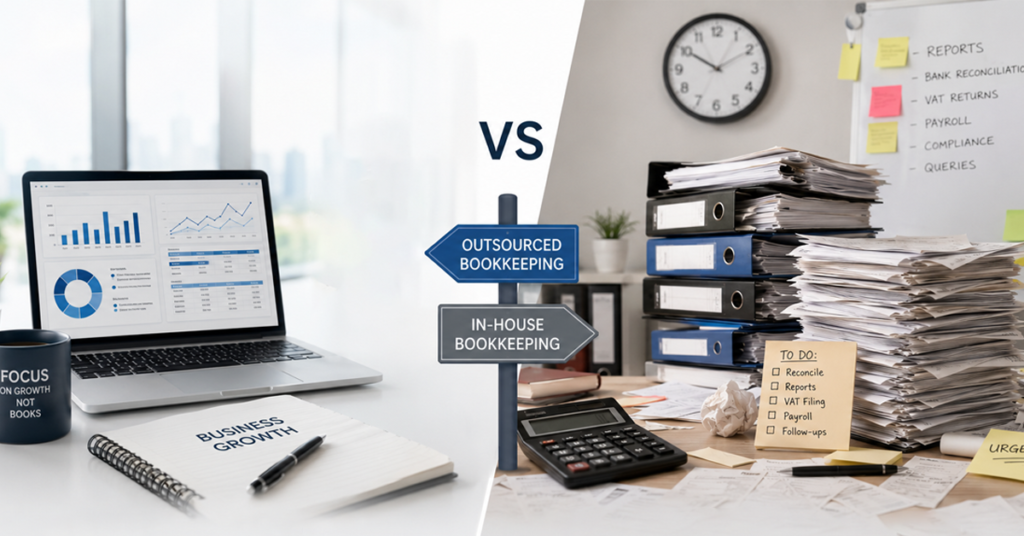
Professional bookkeeping services Hong Kong are crucial for many SMEs. It helps them stay compliant, enhance reporting accuracy, and allocate internal resources to grow their business.
Startups, expanding SMEs, international founders, and businesses looking for reliable financial data but without the expense and hassle of an in-house accountant may find outsourcing to be a better fit.
It’s especially helpful if consistency, compliance support, and reporting are the main priorities and not having a person on-site full-time. Bookkeeping is a necessary service for many businesses but not one that they want to develop in-house.
Hence, many businesses opt for our bookkeeping services as it helps them keep their records accurate, enhances their reporting, and alleviates administrative pressure. The value is not only in recording transactions. It is in reducing administrative strain and giving business owners confidence that key finance tasks are being handled properly.
How to decide without overcomplicating it
Start with your current pain points. If the problem is lack of expertise, poor continuity, or too much founder involvement, outsourcing is often the cleaner fix. For ongoing, real-time departmental coordination, in-house might be preferable.
Next, examine volume and complexity. If you’re operating a small business that has less activity each month, you probably don’t require a full-time internal bookkeeper. May is a business with high daily turnover, multiple approvals, and a variety of stakeholders internally.
Last but not least, tell the truth about management ability. Having in-house does not take away the work unless you are prepared to manage, train, and organize the job. Outsourcing makes more sense for owners who want a more managed solution.
The best option is the one that provides you with accurate records, timely reporting, and less of a distraction in your operations. If your bookkeeping system complicates decision-making, it’s not the jobkeeper who needs to change; it’s the system!
FAQs
1. What is the difference between outsourced bookkeeping and in-house bookkeeping?
In-house bookkeeping means that you have got an employee in your business who handles bookkeeping; outsourced bookkeeping means an external accounting firm. An outsourcing solution has the advantage of using experienced individuals. While an in-house team will be able to provide direct day-to-day access.
2. Is outsourced bookkeeping more cost-effective than hiring an in-house bookkeeper?
Most startups and SMEs find it more affordable to have bookkeeping outsourced. Since the expenses associated with hiring staff, benefits, training, or software are avoided, and a professional financial expert is on board for their business for a fixed monthly fee.
3. Is outsourced bookkeeping suitable for businesses in Hong Kong?
Yes. Outsourced bookkeeping Hong Kong services are an ideal solution for many SMEs who want to keep their financial records accurate, comply with regulations, and save on administrative burden without adding to their expenses on hiring a full-time finance team.
4. Can outsourced bookkeeping help with tax compliance?
Yes. Bookkeeping services Hong Kong prepare actual financial statements, ensuring that companies can submit their taxes in time and that there are no costly mistakes that will lead to additional charges.
5. When should a business switch from in-house to outsourced bookkeeping?
Outsourcing should be taken into consideration when bookkeeping is time-consuming, resources are limited, accuracy is compromised, or a business desires financial expertise without the growth of its finance department.