




If you are working out how to open a Hong Kong limited company for a new venture, the real question is usually not whether it can be done quickly, but whether it can be done correctly. A smooth incorporation is only the first part. The decisions you make at the start affect your banking setup, tax position, internal records and your ability to stay compliant without constant disruption.
A Hong Kong limited company is an established, flexible company structure that is well-known, easy to own and appropriate for both local and international trade, and is a practical solution for founders, start-up enterprises and expanding SMEs. It also provides better clarity between the business and the individual, which is needed when entering contracts, seeking investors, or creating a long-term operation.
This business structure is one of the most favored business structures for local and International businesses and is known as an HK Ltd company.
How to open a Hong Kong limited company the right way

There are generally five key decisions to make when forming a limited company in Hong Kong: Company Name, Business Activities, Shareholders, Directors and Registered Office. This is simple stuff that’s easy to get right, and where unnecessary delays can start.
Your company name must be acceptable for registration and should not conflict with existing names. It also needs to work commercially. A clear name that is available is better than one that is not, but is confusing to customers or banking partners. For businesses looking to expand their reach beyond their own country, it’s advisable to see if the name is easily translatable to other markets and if there are appropriate brand assets to match.
You will also need to define the company structure. A private company limited by shares is the most common option for entrepreneurs and SMEs. In practical terms, this means the company is a separate legal entity and ownership is represented by shares. The structure is familiar to suppliers, clients and financial institutions, which helps when you are setting up operations.
At the same time, you need to confirm who will act as director and who will hold shares. In many cases, one person can be both the sole director and sole shareholder. In others, there may be multiple founders, a holding company, or overseas owners. The correct setup depends on how profits will be distributed, who controls decisions, and whether future investment is expected.
If you are still deciding which business structure best suits your goals, comparing Hong Kong company structures before incorporation can help you choose the most suitable option for your ownership, tax and growth plans.
The documents and details you need
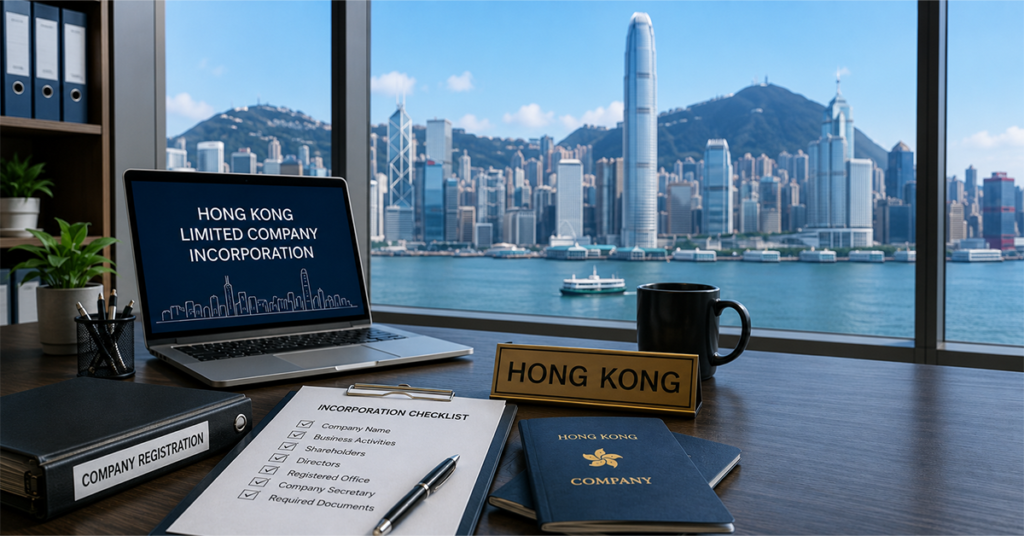
To understand how to open a Hong Kong limited company efficiently, it helps to know what information is normally required before the application is submitted. Most delays happen because the paperwork is incomplete or inconsistent.
You will usually need identification and address proof for directors and shareholders, details of the registered office, and the company’s constitutional document. If a corporate shareholder is involved, additional supporting records are normally required. The authorities and service providers will want the information presented clearly and consistently, especially where overseas parties are involved.
If you do not require physical premises, a virtual office Hong Kong solution can often satisfy the registered office requirement while helping reduce operating costs.
A company secretary must also be appointed. This is not an optional administrative extra. It is a statutory role that supports the company in maintaining proper records and meeting filing obligations. Founders sometimes underestimate this point and assume incorporation ends once the certificate is issued. In reality, company secretarial support is part of the operating framework of the business from day one.
There is also the designated representative requirement linked to significant controllers record keeping. This is another area where many new business owners prefer professional support, not because the rules are impossible to understand, but because accuracy matters and mistakes tend to surface later when you are already busy running the business.
Registration is only one stage
Once the incorporation documents are prepared and submitted, the company can be registered and the relevant business registration process completed. At that point, you have a legal entity, but not necessarily a business that is ready to trade smoothly.
That distinction matters. Founders often focus on the registration certificate and assume the difficult part is over. In practice, there is usually a second wave of setup work involving business bank account preparation, internal share records, statutory registers, accounting arrangements and compliance planning.
This is where professional Hong Kong company formation services can save time. If incorporation is handled in isolation, the founder is left to piece together the next steps with different providers. If the process is managed as one connected service, the business starts with cleaner records, clearer responsibilities and fewer gaps.
Professional incorporation services Hong Kong providers offer incorporation services together with company secretarial, compliance, and post-incorporation support.
Banking and operational readiness
A common frustration for new companies is that incorporation can be faster than banking. That is not unusual. Banks and payment institutions carry out their own checks and often want to understand the company activity, ownership, expected transaction profile and commercial rationale.
So, if you are considering how to open a Hong Kong limited company, prepare for banking at the same time rather than afterwards. Your business plan doesn’t have to be dramatic, but it should be coherent. If you say the company will provide consulting services, sell goods internationally and receive payments from multiple countries, your supporting explanation should be realistic and consistent with your records.
It also helps to have your accounting process considered early. Clear bookkeeping and financial reporting, expense capture and invoicing system – even simple businesses benefit from it. It is almost always better to wait until the first deadline nears to receive more corrections; it is more stressful and less visibility over business performance.
For startups and SMEs, outsourced accounting support is often the practical choice. It gives you structure without the cost of building an internal team too early. More importantly, it creates continuity between company formation and ongoing compliance, which reduces the risk of missed filings or poor record-keeping.
Cost, timing and the trade-offs involved
There is no single answer to cost because it depends on the complexity of the ownership structure, the level of support required and whether overseas parties are involved. A straightforward single-owner company is naturally easier to process than a business with multiple corporate shareholders and layered documentation.
Timing also depends on preparation. If documents are ready, the structure is clear, and there are no naming issues, the process is generally more efficient. If there are repeated amendments, uncertain shareholder arrangements or inconsistent identity documents, delays are more likely.
When evaluating service providers, look for transparent pricing so you understand exactly what is included in the incorporation package and any ongoing compliance costs.
Some entrepreneurs attempt to cut costs by working on their own. That is fine in some situations, particularly if the owner is OK with reading the rules and carrying out follow-up duties. The balance is time and risk. When the business owner is already busy with the operations, sales, and hiring, administrative mistakes can end up costing the business a lot.
Professional support isn’t just about completing one form; it’s about minimizing rework. It assists in ensuring that the company isn’t merely established, but it is structured in a manner that is conducive to accounting and compliance and future business operations.
Common mistakes when opening a company
The most common error is considering incorporation as a “one-shot” deal. A company continues to have responsibilities, and small or new companies do not lose them.
The other error is picking a structure without considering anything more than the initial few months. A setup that seems simple today may become awkward when a new shareholder joins, when profits need to be distributed differently, or when the business starts operating across borders.
A poor record-keeping system is also a common problem. Once the shareholder decisions, company registers and financial records are not properly maintained from the beginning, the clean-up work carried out later is seldom efficient. This is why many business owners opt for a supplier who is prepared to take care of the incorporation, company secretarial and bookkeeping instead.
Another problem is the lack of appreciation for local procedural knowledge. It takes experience to make the rules work in practice, even when they are publicly available. An understanding of what is often the cause of delays, what will banks typically require, and how to ensure that records are prepared correctly can significantly minimise the time taken to set up and reduce uncertainty.
When to get help with how to open a Hong Kong limited company
If your business has a single founder, a standard service model and straightforward ownership, the process is usually manageable with the right guidance. If there are overseas shareholders, group structures, nominee arrangements, or plans for rapid expansion, professional support becomes much more valuable.
The same applies if you do not want to build an in-house administrative function. Many founders do not need another task list. They need one accountable partner who can handle company formation, statutory support, bookkeeping, tax filing and annual maintenance in a joined-up way. That is often the difference between a company that merely exists on paper and one that operates with control.
Gee Kay Systems & Accounting Limited works with businesses that want that continuity from the start, so the formation stage is aligned with the records and compliance work that follows.
Opening a company should give you a platform for growth, not a trail of administrative loose ends. If you approach the process with the end in mind – banking, bookkeeping, compliance and day-to-day control – you are far more likely to build a company that stays efficient as it grows.
FAQs
1. How do I open a Hong Kong limited company?
Pick a company name, elect directors and shareholders, develop the documents, designate a company secretary, and file the incorporation application.
2. Can a foreigner open a Hong Kong limited company?
Yes. Foreign persons and overseas companies are permitted to incorporate a limited company in Hong Kong as long as the incorporation requirements are fulfilled.
3. What documents are needed to register a Hong Kong limited company?
Directors and shareholders will typically need to provide their identification and address proof, registered office details, and the company’s constitutional documents.
4. How long does it take to open a Hong Kong limited company?
The duration may vary depending on the extent of your paperwork and company organization, but simple applications will be completed faster.
5. Do I need a company secretary for a Hong Kong limited company?
Yes. A company secretary is a crucial role for every limited company established in Hong Kong to assist companies in fulfilling statutory filing requirements and compliance.