




A Hong Kong company can often be incorporated quickly, but incorporation is only the first administrative step. The real work is setting up a structure that supports your ownership plans, banking arrangements, records and statutory responsibilities from day one. If you are considering how to open a business in Hong Kong, the most reliable approach is to plan for ongoing operation as carefully as registration.
For founders, overseas operators and growing SMEs, Hong Kong remains an attractive base because of its established commercial environment, straightforward incorporation process and territorial approach to profits tax. But those benefits do not remove the need for accurate records, timely filings and clear management of your company’s obligations.
One of the most crucial steps in setting up a company in Hong Kong is careful planning when a founder plans to conduct business globally.
Start by choosing the right business structure

Understanding the different Hong Kong company types is the first step before registration. The right structure depends on who will own and run the business, the level of liability protection required and whether the business is intended to grow, hire staff or work with international customers.
For many entrepreneurs, a private limited company is the practical choice. It creates a separate legal entity from its owners, which generally helps protect personal assets from business liabilities. It can also provide a more credible structure for suppliers, customers, investors and banks.
A sole proprietorship may suit a very small local operation with low commercial risk, but the owner remains personally responsible for the business’s debts and obligations. A partnership can work where two or more people want to trade together, although the partners should agree clearly on control, profit sharing and responsibility before starting.
A private limited company Hong Kong requires at least one director and one shareholder. The same person can hold both roles. Conveniently, directors and shareholders are not required to be Hong Kong residents. The company is required to have a registered office address in the area and must have a company secretary who complies with the local eligibility criteria.
Before registering, comparing Hong Kong company structures can help you to decide which one is best for your ownership, tax and growth objectives.
Decide on ownership, management and company details early
Settle the details that are reflected in your company records before applying. They can be changed later, but that also requires additional management and may cause a delay in other procedures like opening a business account or entering into commercial contracts.
Choose a company name that is distinguishable from existing registered names and does not contain restricted wording without permission. An English name, a Chinese name or both may be used, but the names should be checked before filing.
You will also need to confirm the share structure. Private limited companies do not have a minimum share capital requirement, and many start with a small amount of capital. The question is not just how many there are, but if the number of shares issued represents the actual ownership, voting rights, and intentions to invest in the future.
Directors manage the company; shareholders own it. The roles are frequently combined in a founder’s business. If there are several owners, it is wise to agree on the manner of major decisions, what happens when a shareholder dies, and whether it is possible to transfer shares to others. A written shareholders’ agreement can prevent difficult misunderstandings later.
Register your company and business
The incorporation process generally involves submitting the prescribed incorporation form and the company’s constitutional documents to the Companies Registry. Once approved, the company receives its Certificate of Incorporation. A Business Registration Certificate is issued as part of the registration process.
Another factor many founders consider is the Hong Kong company setup cost. The total cost depends on government fees, company secretary services, the registered office, and any professional assistance used during incorporation and ongoing compliance.
The information submitted normally includes the proposed company name, registered office, director and shareholder details, share capital and the company secretary’s particulars. Information must be accurate and consistent with supporting identity and address documents. Small discrepancies can slow down applications and create problems when a bank or payment provider carries out its own checks.
Using professional Hong Kong company formation services can make this stage more straightforward, particularly where there are overseas shareholders, corporate shareholders or more complex ownership arrangements. The value is not merely in completing a form. It is in ensuring the registered structure reflects how the business will operate and that the statutory records are properly established.
Our Hong Kong business registration guide provides a step-by-step checklist if you want to know more about the incorporation process.
Maintain a registered office and company secretary
Every Hong Kong private limited company must have a registered office in Hong Kong. This is the official address for statutory correspondence and government notices. It does not have to be the place from which the business trades, but it must be monitored reliably.
The company secretary is a separate statutory role. For a company with a sole director, that director cannot also act as company secretary. The secretary helps maintain company records, prepares required filings and supports the company in meeting corporate deadlines. For non-resident founders, engaging a local professional company secretary is usually the simplest and most dependable arrangement.
The company must also maintain a Significant Controllers Register. This records individuals or legal entities with significant control over the company. A designated representative must be available to assist authorised law enforcement officers with access to that register when required.
Set up banking and operational finance carefully
Incorporation does not automatically give you a Hong Kong company with a bank account. Banks and financial institutions make their own decisions, often based on the nature of the business, ownership structure, expected transaction activity and the evidence provided.
Prepare a clear business profile before applying. This may include a concise explanation of the business model, expected turnover, source of funds, supplier or customer information, contracts where available, and identification documents for directors and beneficial owners. A well-prepared application gives the reviewer a clearer picture of the company’s commercial purpose.
Do not mix personal and company money once the business begins trading. Use a dedicated company account, retain invoices and payment evidence, and document any funds introduced by an owner as share capital, a loan or another properly recorded transaction. This discipline makes bookkeeping easier and gives management a more accurate view of cash flow.
For businesses that process regular supplier invoices, sell across borders or manage several currencies, the finance process should be designed early. The right accounting system and approval controls can save significant time as transaction volumes increase.
Understand tax before the first sale
Hong Kong applies a territorial basis of taxation, but this does not mean every business operated through a Hong Kong company is automatically free from profits tax. Tax treatment depends on the facts, including the nature of the income and where the profit-generating activities take place.
Founders should avoid making assumptions based solely on where customers are located or where payments are received. Contracts, decision-making, staff activity, service delivery and the location of key business functions may all be relevant. A business with cross-border operations should obtain advice based on its actual commercial arrangements rather than rely on a generic offshore claim.
Registering the company is also the beginning of its tax record. Keep invoices, receipts, contracts, bank statements, payroll information and supporting documents in an organised system. Good records are not only about meeting obligations. They can assist you in monitoring margins, cash flow, and hiring, pricing, and expansion decisions.
The company will also be responsible for payroll and employer reporting if they have employees. These should be set up before the first salary payment, not corrected months later when records are harder to reconstruct.
How to open a business in Hong Kong and stay compliant
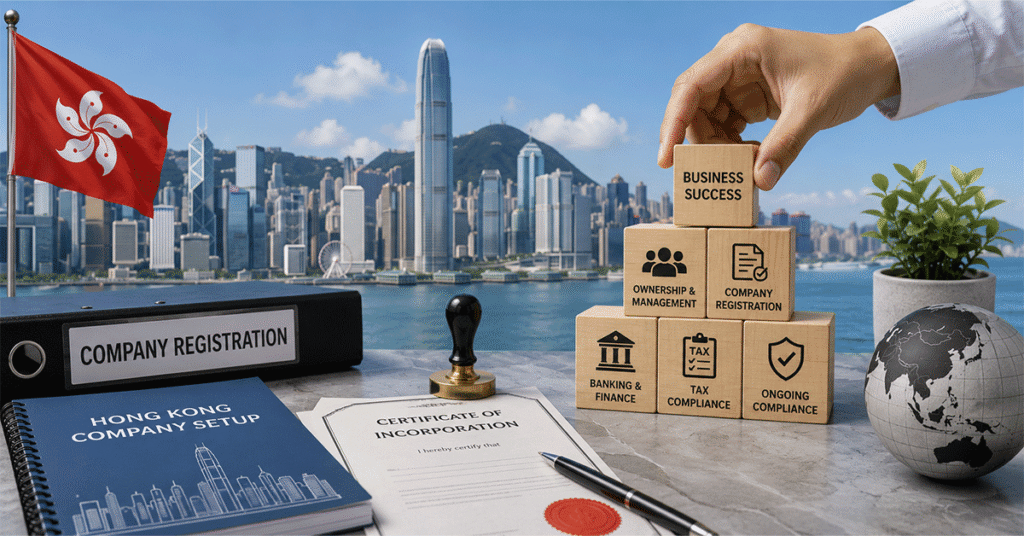
A company’s responsibilities continue after incorporation. Private limited companies must keep statutory registers and accounting records, submit an annual return, renew business registration when due, and respond to tax and other government correspondence on time. They must also prepare annual financial statements in accordance with applicable requirements.
Deadlines matter. Penalties for late filing and unnecessary pressure on directors for repeated delays. Many startup founders decide to delegate company secretarial duties, bookkeeping, and tax preparation as these tasks are continuous and due. It is often more efficient than asking a founder or operational employee to learn every requirement while running the business.der or operational employee to learn every requirement while running the business.
The right level of support depends on the business. A dormant company may need only essential maintenance, while a trading company with employees, stock, overseas suppliers or frequent transactions needs more regular financial management. As the business grows, monthly bookkeeping and management reporting can turn compliance records into useful commercial information.
Build the business around sound administration
Opening a company is most effective when legal administration, financial records and commercial operations work together. Register the correct structure and keep the ownership position clear. It establishes reliable record-keeping and treats deadlines as part of normal business management rather than an annual disruption.
GEEKAYSYS supports founders and SMEs with company formation, company secretarial services, bookkeeping, tax support and ongoing compliance under one accountable provider. That can reduce the burden of administration while giving owners clearer visibility of their company’s position.
A well-managed business does not have to focus on paperwork. It requires a reliable back-end system, which allows the business builders to focus on customers, opportunities and sustainable growth.
Still looking for answers to common Hong Kong business setup questions? The FAQs below cover the issues founders ask most before registering a company.
What is the best business structure for opening a business in Hong Kong?
The private limited company is the most suitable one for most entrepreneurs owing to its limited liability and future flexibility.
FAQs
1. What is the best business structure for opening a business in Hong Kong?
The private limited company is the most suitable one for most entrepreneurs owing to its limited liability and future flexibility.
2. Can a foreigner open a business in Hong Kong?
Yes. A private limited company may be incorporated in Hong Kong and be managed by non-residents of Hong Kong, including foreign persons and firms.
3. Do I need a company secretary to register a Hong Kong company?
Yes. Every private limited company in Hong Kong will require an eligible company secretary and have a registered office in Hong Kong.
4. Is opening a Hong Kong company enough to start trading?
No. Once legally incorporated, you will need to establish a business bank account, keep proper accounting records, and settle tax liabilities. Also, comply with the ongoing statutory filing requirements.
5. What are the ongoing compliance requirements for a Hong Kong company?
Companies are required to keep statutory records, submit annual returns, renew business registration, prepare financial statements, and make timely tax filings.