



A company may be doing a great job with its trading, payments to suppliers, and everything else, and still have a compliance problem right under its nose because its statutory registers are not up to date. When it comes to maintaining statutory registers properly, it is not simply a case of record-keeping. It’s about maintaining the legal viability of your business, ensuring that there is a clear track of decisions made and ensuring that the right information is made available when it is needed.
Founders and SME principals tend to see the statutory registers as background until they become an issue because of a deadline, banking or corporate changes. This is when it is easy to see a small gap will start to form. There may be unwelcome bumps and bruises if the share transfer is not entered on time, or if the beneficial owner is not set up, or if the beneficial owner information is incomplete.
Why it matters to maintain statutory registers properly

Statutory registers are part of a company’s formal records. They reveal important information including the identities of the directors, the who, how and what of the shareholders and the major changes over time. It is not something that can be done by the admin when it is not a pressing priority. They support the legal identity and governance history of the company.
When these records are maintained properly, the business benefits in practical ways. Ownership can be verified quickly. Corporate changes can be tracked clearly. A shared version of the facts for use by internal teams and external stakeholders. This is important when opening bank accounts, filing annual compliance documents, engaging in investor conversations, or responding to requests from the regulators.
This is also the case, but in reverse. Dirty registers lead to confusion. When the company’s records and resolutions and the company’s actual business structure don’t agree, it can take time for management to clear up inconsistencies. That sometimes results in a penalty, delay, or a tarnished reputation.
What statutory registers usually include
The exact registers required depend on the company type and jurisdiction. But for many businesses, the core records include the register of members, the register of directors, the register of company secretaries, and records relating to persons with significant control or beneficial ownership where applicable. There may also be registers covering charges, share allotments, transfers, and director interests, depending on the legal framework involved.
For companies doing business in Hong Kong, company records should be maintained in accordance with the requirements of Hong Kong and should be kept current for any relevant change. It seems simple enough, but it’s usually an operational problem, not a technical one. In rapidly expanding companies, change is rapid. A founder elects a new director, issues shares to an investor, alters the registered office, or alters ownership.
If the register update is not built into that process, the records fall behind.
Many companies also work with a Hong Kong share registrar provider to ensure shareholder records, share transfers, and statutory registers remain accurate and compliant.
The biggest reason registers become inaccurate
In most SMEs, the problem is not a lack of intent. It is fragmented responsibility. One person handles incorporation documents, another keeps board minutes, someone else manages bookkeeping, and no one owns the full compliance record. As a result, information exists, but not in one reliable place.
This is especially common when a business grows from founder-led operations into a more structured company. In the early stage, informal decisions are common. Later, those same decisions need formal documentation and register updates. If the business does not adjust its processes, gaps appear.
There is also a timing issue. Many business owners assume the annual return is the main checkpoint. In reality, statutory registers should be updated when changes happen, not months later when someone prepares year-end paperwork. Waiting creates a risk that details are forgotten or documents become inconsistent.
How to maintain statutory registers properly in practice
The most effective approach is to treat statutory records as part of normal business operations, not as an isolated compliance task. Every corporate event should trigger a documentation review. Any changes that impact upon ownership, management or control or registered particulars should be immediately checked and updated to the registers.
The first step is to determine what registers your business needs to keep and where they are stored. There are still companies that use paper records, but there are companies that have digital records that are backed up by either company secretarial software or outsourced services. Either can work, but only if the records are complete, secure, and easy to retrieve.
Next, compare the current registers against the company’s actual position. Confirm directors, shareholders, allotments, transfers, secretarial, registered address, and beneficial ownership information that must be recorded. This review will often identify old omissions that were passed on from previous years.
After that, establish a clear process for future updates. This should include who is responsible, what documents are needed, when the update must be made, and how related filings are handled. A simple internal checklist is often enough, provided someone is accountable for using it.
Common events that should trigger register updates
Many record gaps come from routine changes that feel operational rather than statutory. A new shareholder coming in through a private investment round is an obvious example, but smaller changes matter too. A director resignation, a share transfer between existing owners, or an update to a company secretary appointment can all require the registers to be amended. Other compliance changes, such as appointing a designated representative, should also be reflected in the relevant statutory records where required.
Changes in beneficial ownership deserve particular care. If the company must keep a significant controllers register or similar record, it is not enough to update the shareholding chart informally. The statutory record itself must reflect the current position, supported by the right documentation.
It is also worth checking whether a single event affects more than one register. An allotment of shares may require updates to the register of members, allotment records, board resolutions, and related filings. Handling only part of the chain is a common source of inconsistency.
Paper records versus digital records
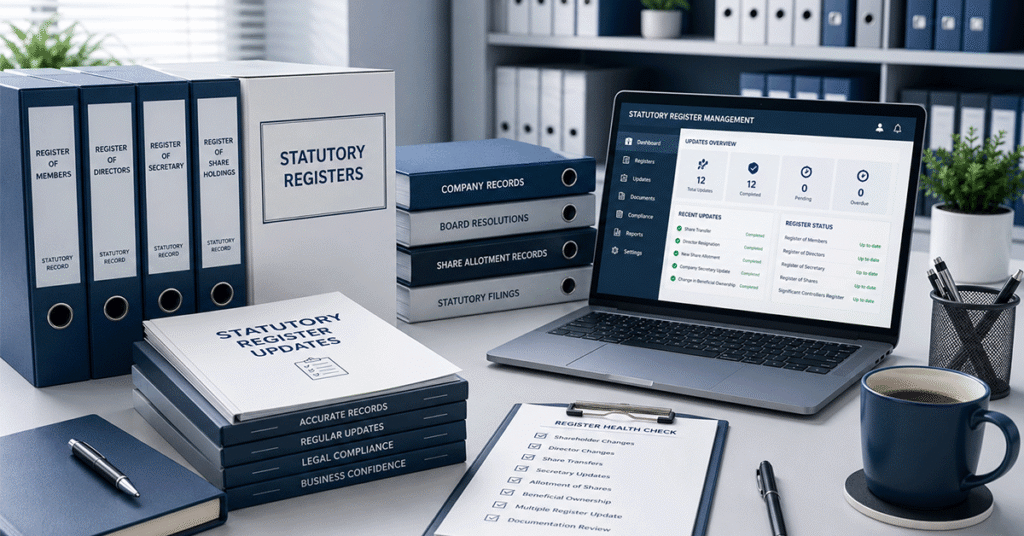
There is no one answer to this. Even though paper registers are not as convenient, when they are carefully kept and stored in a secure location, they can still be compliant. It’s a strategy that is recognizable and manageable for some small businesses. The downside is that paper-based systems are more prone to being overlooked, more difficult to search, and more susceptible when multiple parties need to use them.
Digital records are typically more straightforward to keep, particularly for businesses that experience frequent changes or international investors. They provide quicker retrieval, easy version control, and simplified coordination with the annual compliance effort. However, if it is not managed, a digital system can be of little use. A folder of scanned documents will not do the job of a well-kept register.
A growing business is more likely to be best suited to a managed process with a professional provider. That reduces dependency on one internal staff member and lowers the chance of records slipping during busy periods.
When outsourcing makes sense
Not all companies require an internal compliance office. Actually, if you are a startup or SME, that’s an unnecessary expense for you. An experienced company secretary in Hong Kong will help you keep up-to-date statutory registers and comply with the annual filing requirements and regulations. When the business is looking for accuracy, continuity, and one point of accountability, outsourcing record maintenance of statutory records may be the better choice.
A provider experienced in corporate secretarial, bookkeeping, and annual filing services can identify problems sooner since they’re reviewing the records simultaneously and not separately. That matters when a change in ownership also affects tax records, payment authorities, or financial reporting support.
Our Hong Kong company secretary service works with businesses that want this kind of joined-up support. For founders, the practical value is simple: fewer moving parts, less chasing paperwork, and greater confidence that company records are being handled properly.
Mistakes to avoid
One common mistake is assuming that filed forms automatically replace the need to update the registers. They do not. Filing and register maintenance are related, but separate, obligations. Another is relying on memory or email trails instead of formal resolutions and dated records.
It is also a problem for businesses if they see statutory registers as a clean-up once-a-year exercise. Keeping records up to date once is helpful, but if there’s no process behind that, then the same issues reappear. It isn’t enough to put in a few tries; consistency is key.
Last but not least, don’t underestimate the frequency of commercial activity’s compliance consequences. Changes in investors, signatories, the issuance of new shares, or changes to a group can appear to be business decisions first, and only record-keeping implications later, but almost always.
A better way to stay compliant
Don’t wait until a problem occurs, and then have to do a health check of your registers. It is easier to correct records calmly than under pressure from a transaction, bank request, or filing deadline. Well-maintained statutory records also make it easier to obtain a certificate of continuing registration when banks, investors, or government authorities request proof of the company’s good standing.
Combining register maintenance with an annual company maintenance service also helps businesses stay ahead of filing deadlines and ongoing compliance obligations.
To maintain statutory registers properly, the goal is not paperwork for its own sake. Its purpose is to maintain an accurate, up-to-date and reliable legal record of the company as it expands. Once the foundation’s there, daily compliance is much less disruptive, and you can spend more time on business operations, with confidence.
FAQs
1. What are statutory registers in a company?
Statutory registers are official company records that include information about the directors, shareholders, company secretaries, ownership of shares, and other information required by the law.
2. How often should statutory registers be updated?
Changes to statutory registers should be made immediately after the change, whether this is changing a director, issuing shares, transferring shares, or changing the company secretary.
3. Why is maintaining statutory registers important in Hong Kong?
Properly maintained registers help businesses comply with Hong Kong regulations, avoid penalties, support annual filings, and provide accurate records during audits or due diligence.
4. Can I outsource statutory register maintenance?
Yes. Professional company secretarial firms can help many SMEs maintain statutory registers to ensure records are accurate, compliant, and kept up to date.ng for maintaining the statutory registers, which helps to keep records accurate, compliant and up-to-date.
5. What happens if statutory registers are inaccurate?
Incomplete registers might cause compliance problems, fines, financial issues in banking or investment processes, or auditing challenges.