




A change in shareholders can look straightforward on a cap table, but a Hong Kong private company cannot simply amend a spreadsheet and move on. A proper Hong Kong share transfer guide starts with the company’s own rules, follows the required approval process, and leaves a clear record of who legally owns the shares. The right sequence means that the owner who is selling will be protected, the owner who is buying will be protected, and the company’s statutory records will be prepared for inspection.
The real problem for founders, SMEs, and foreign owners is often the commercial deal. It is coordinating the transfer documents, stamp duty, board approval, and company records without creating delays or uncertainty over ownership. The process explained below is what should occur and how professional company secretarial support can ease the administrative load.
When is a share transfer needed?
A share transfer happens when a current shareholder sells, gives or transfers a part of or all of their shares to another shareholder or entity. The recipient can be a co-founder, investor, family member, employee, holding company or third-party purchaser.
This is not a new issue of shares. If a new issue is made, the number of shares in the company increases, and the amount of money raised from the issue is usually considered new capital. If you are transferring shares, the number of shares issued would not change because you are simply changing hands.
It’s important because the documents, approvals and the legal implications are all different. Check if the proposed arrangement is for a transfer, or a new allotment, or both.
Start with the articles and shareholder arrangements
The company’s articles of association should be the first document reviewed. Many private companies restrict the directors’ ability to register a transfer, or give existing shareholders rights before shares may be sold to an outside party. Common provisions include pre-emption rights, rights of first refusal and directors’ approval requirements.
A shareholders’ agreement may add further obligations. For example, it might require a departing founder to offer shares to existing owners first, obtain investor consent, or transfer shares on particular terms after leaving the business. A transfer that overlooks these provisions can lead to disputes even where the parties have signed a sale agreement.
Check, in particular, examine whether the shares are fully paid, whether there are proposals to restrict the proposed transferee, and whether it is necessary for any shareholder or investor to agree to the transfer. When the seller is a corporate shareholder verify that the seller has approved the transaction under its internal procedures.
Agree the commercial terms before filing paperwork
The parties should come up with an agreement on what’s being transferred, on what date, and the price. If there is an ongoing business relationship, a brief written contract might suffice. Where the value is material or the transfer is connected with an investment, exit or dispute settlement, more detailed legal documentation may be appropriate.
The consideration should be clearly stated. As a general rule, the stamp duty will be determined in accordance with the greater of either the consideration paid or the value of the shares, and it is not necessary to ensure that the prices are artificially low in order to minimise the stamp duty payable. This is especially applicable to transfers between related parties, gifts, reorganization and transfers between companies under common ownership.
Valuation does not have to be difficult but must be defensible. Recent funding, net assets, trading performance, debts outstanding to the company and any agreed shareholder rights can all have an impact on value. When there is no evident market valuation, advice obtained before submission on appropriate valuation can avoid questions and delays.
Prepare the share transfer documents
The core document is the instrument of transfer. It specifies the transferor, transferee, company, class and number of shares and consideration. This should be filled in and signed by the appropriate persons.
Depending on the situation, supporting documents can be the sale and purchase agreement, board resolutions, a share certificate, valuation information, identity and/or corporate authorisation documents. The company may have to comply with its lost share certificate procedure before it issues a replacement certificate or makes a record of transfer if the transferor is unable to find the original share certificate.
Certain precautions must be taken in the event of the death of a shareholder, their incapacity or entry into insolvent proceedings. The person who is entitled to receive the shares may require evidence of authority, such as probate or letters of administration. These cases should not be treated as a standard sale.
Signing from outside Hong Kong
International shareholders can usually sign transfer documentation outside Hong Kong, but execution formalities still matter. Individuals should sign in their personal capacity. Companies should sign in accordance with their constitutional documents and the law of their place of incorporation. It is sensible to confirm the signing requirements early rather than discover a defect after documents have been submitted for stamping.
Arrange stamp duty before registration
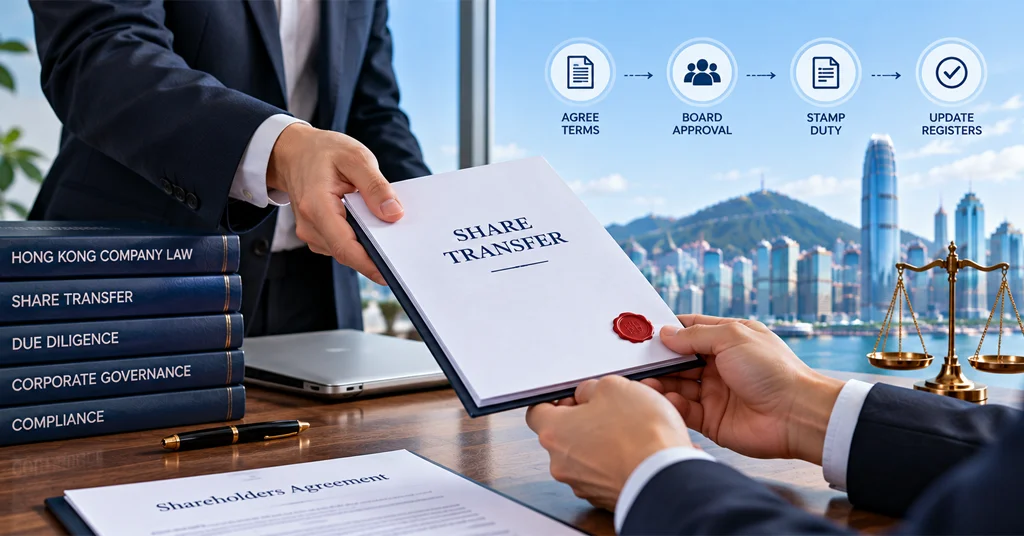
Hong Kong stamp duty is a central part of the share transfer process. In a typical transfer of Hong Kong stock, duty is payable at an aggregate rate of 0.2% of the higher of the consideration or the shares’ value. In practice, the buyer and seller commonly bear 0.1% each, although the commercial agreement can allocate the cost differently between them.
A fixed duty may also apply to the instrument of transfer. The exact treatment can depend on the transaction structure and supporting documents. Transfers within a qualifying corporate group may potentially be eligible for relief, but this is conditional and should be considered before the documents are submitted.
The documents must be presented for stamping within the applicable statutory timeframe. Do not assume that a transfer is complete merely because both parties have signed. The company should not register the transfer until the document has been duly stamped or the appropriate treatment has been confirmed.
Late stamping can result in penalties. More importantly, it can hold up the board’s approval and leave the parties in an awkward position where the commercial deal has closed but the company register has not been updated.
Obtain board approval and register the transfer
Once the transfer documents have been stamped, the directors should consider the transfer in line with the articles.If approved, the board resolution should record the decision to register the transfer, cancel or retain the old certificate as appropriate, and issue a new share certificate to the transferee. Issuing share certificates should be handled alongside the update to the company’s statutory ownership records.
The company must then update its register of members. This is the key statutory record of legal share ownership. The transferee becomes a member when their name is entered in that register, not simply when an agreement is signed or payment is made.
The register should show the new member’s name and address, the date they became a member, and the number and class of shares held. The register of transfers and share certificate records should also be maintained properly. Good records are particularly useful in the event of a future investment request, sale of the business, opening a bank account or settling a shareholder dispute.
Update related compliance records
A share transfer does not usually require a separate immediate filing with the Companies Registry solely because ownership has changed. However, the revised shareholder position must be reflected in the company’s next annual return. Companies should also review whether their Significant Controllers Register needs updating.
Companies should also consider if their SCR requires updating. A person is a significant controller if they hold, directly or indirectly, more than 25% of the issued shares, have the right to appoint or remove a majority of the directors, or have the right to exercise significant influence or control.
The analysis can be more involved where shares are held through corporate structures, nominees or trust arrangements.
The company should also update its internal ownership schedule, shareholders’ contact details and any bank mandate or signing authority that is changing alongside the transaction. Ownership and management are separate matters, but a founder’s exit often affects both.
Common mistakes that delay a Hong Kong share transfer
The most frequent problems are avoidable. Parties may sign documents before checking pre-emption rights, use an unsupported nominal value, submit incomplete stamping documents, or forget that a corporate seller needs its own approval. Another common error is treating a payment receipt as proof that ownership has legally changed.
It also depends on the company’s history. A simple transfer of a small number of fully paid shares between two existing shareholders is very different from an investor exit, a transfer by an overseas corporate group, or a sale involving several share classes. The larger or more sensitive the transaction, the more valuable it is to confirm the process before signatures are exchanged.
A practical way to keep the process controlled
A well-managed transfer follows a clear order: review the company’s rules, agree terms and value, prepare documents, arrange stamping, obtain board approval, update the register of members and review related compliance records. Trying to reverse that order often creates unnecessary rework.
Gee Kay Systems & Accounting Limited can provide business owners with one point of responsibility for handling company secretarial documentation and continued statutory record keeping, as well as broader accounting and compliance tasks. Its purpose is not to create an unnecessary hassle with a share transfer, rather a proper documentation of a major share transfer so that it does not become a future administrative issue.
Before shares change hands, take the time to verify the company’s rules and the value supporting the transaction. That small step can give every party clearer ownership, cleaner records and greater peace of mind as the business moves forward.
FAQs
1. What documents are needed for a Hong Kong share transfer?
You generally need an instrument of transfer, along with other supporting documents depending on the type of transaction.
2. When is a new share certificate issued?
A new share certificate is generally issued after the transfer has been approved and properly registered by the company.
3. Is stamp duty required for a Hong Kong share transfer?
Generally, yes. It will be calculated based on the consideration received and the market value of the shares transferred.
4. When does the transferee become a shareholder?
The transferee becomes a member when their name is entered into the company’s register of members.
5. Does a share transfer need immediate Companies Registry filing?
Usually not. The updated shareholder information is generally reflected in the company’s next annual return.