



Establishing a business in Hong Kong can seem like a simple process until you have to figure out who owns it, who runs it, and who is in charge of compliance. That’s where the Hong Kong company structure comes into play. Do this right from the beginning of the day, and you will be able to manage your daily activities, banking, reporting, tax filing, and future growth easily.
The structure isn’t just a registration formality or a technicality for founders, SMEs, and foreign investors. It impacts liability, governance, record management, and scaling up with confidence. A company that is set up incorrectly can still be used for trading, but it can often lead to unnecessary tension after that, particularly when investors go in, directors change, or statutory deadlines come into play.
What the Hong Kong company structure usually looks like
Most businesses entering the market choose a private company limited by shares. Typical Hong Kong company structure for start-ups, trading companies, service companies and many owner-managed companies. It’s well-known and offers limited liability. It’s a practical compromise between flexibility and legal detachment from the owners.
A private limited company is a legal entity. That implies the company is able to enter into contracts, own assets, and assume liabilities in its own name. Generally, the liability of the shareholders will be limited to the amount unpaid on their shares. That split is one of the primary motivations for incorporating over using a less formal structure for business ownership for many business owners.
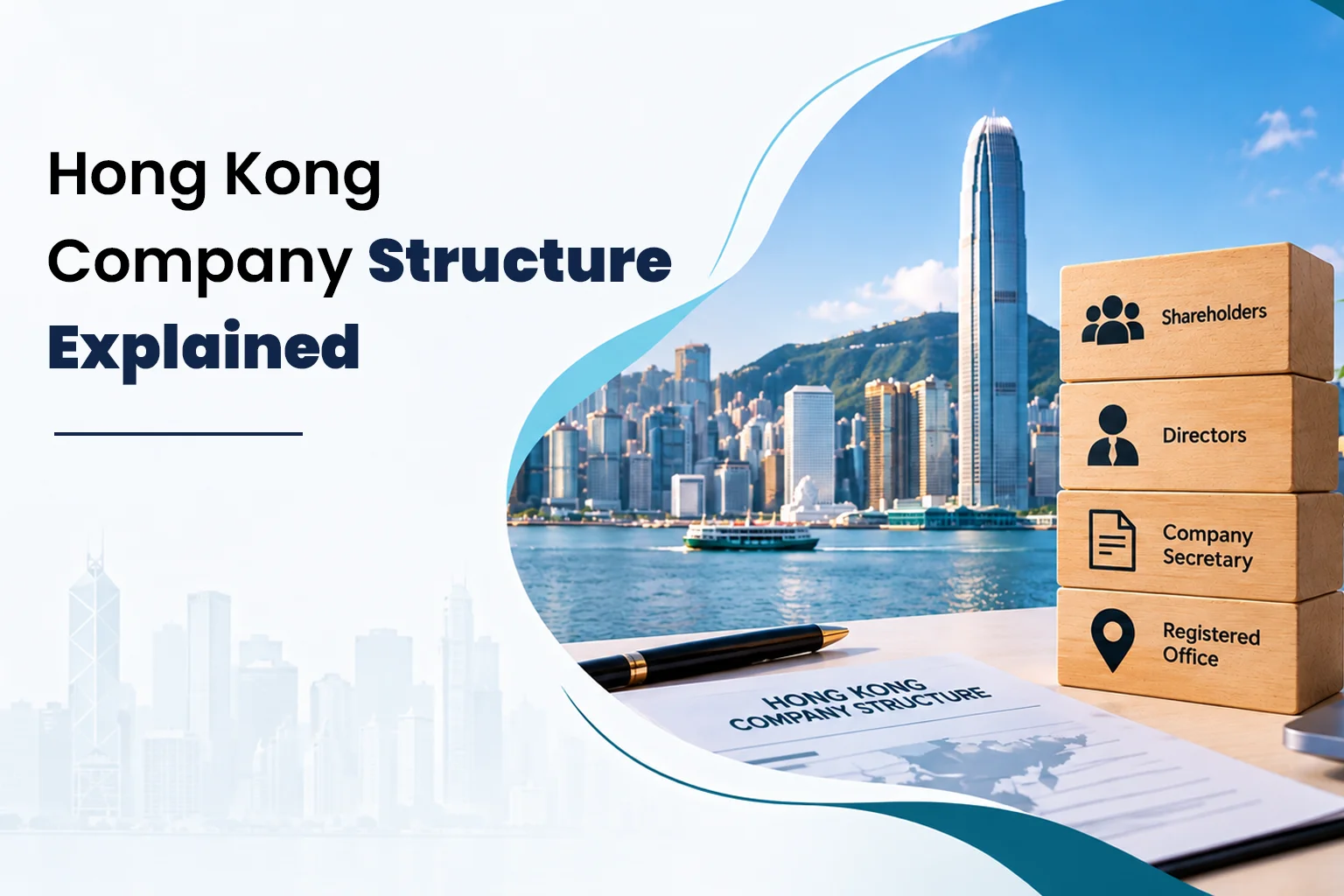
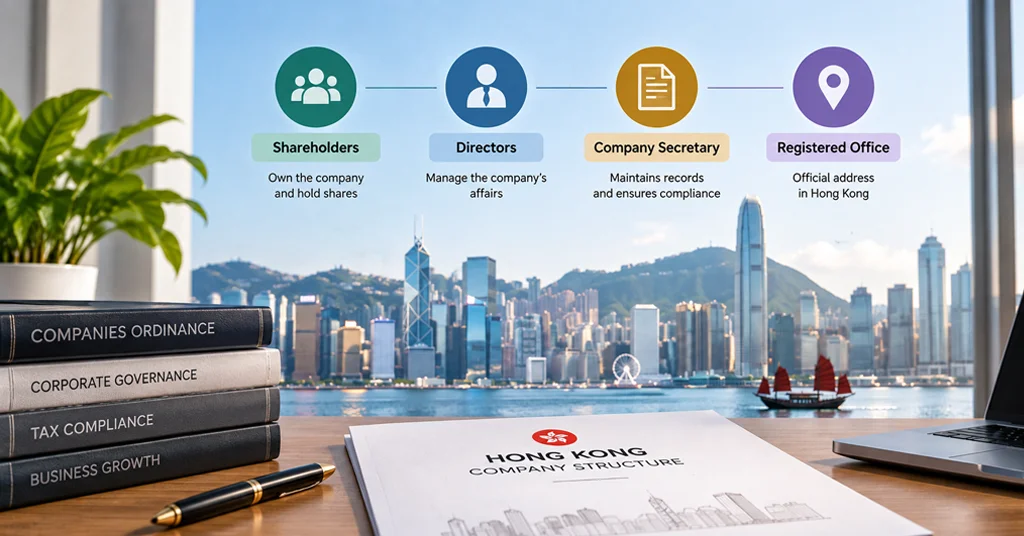
The structure itself is designed as a focal point for a few key roles. You will normally have shareholders, directors, a company secretary and a registered office in Hong Kong. Clear internal bookkeeping, audit preparation and tax compliance arrangements may also be required from the beginning, depending on the nature of the business.
Shareholders, directors and company secretary
The shareholders are the owners of the company. As shareholders, they gain shares and benefit from the value of the company, subject to the rights associated with the shares. The number and identity of the shareholders of a Hong Kong private company may be either one or more, and may be an individual or a corporate entity. If the business is a simple founder-led company, a single person could be the sole shareholder from the outset.
The directors have the duty to run the business of the company. There must be one or more natural persons as directors of a private company. The structure is simple for many startups as the shareholder and director can be one and the same. But ownership and control are not necessarily in the same hands. There can be several founders, with one having a bigger stake and another having a more active role in the business.
Then there is the company secretary. This is not an administrative assistant in the everyday sense. The statutory position of a company secretary is formal in Hong Kong. And the duties include the maintenance of corporate records, preparation of filing documents, and assisting with compliance with the company’s obligations to the Companies Registry. Many small and mid-size businesses hand this to somebody else because of the need for accuracy, consistency, and knowledge of the filing requirements.
A Hong Kong incorporated company is also required to have an address for its registered office in Hong Kong. This is the address for official correspondence and records. It should be a managed address, as it can become a compliance problem if it does not receive official notifications.
Why these roles should not be treated as formalities
Sometimes a founder will only pay attention to speed of incorporation and will leave the roles unspecified. This is good for a while, but issues will arise when cash flow begins. When there is no obvious owner or person in authority to keep records, approve transactions, overlook tax requirements, or prepare for annual tax returns, the company can fall into the no-man’s-land of non-compliance.
That’s why having practical support is as important as the legal setup. A structure that is robust and effective is best when the accounting and reporting functions in the company are mapped out from the outset, not added on later.
Choosing the right shareholding arrangement
The shareholding structure should accurately represent the ownership and funding of the business. A one-man company is easy. More thought is needed for a multi-founder company. Equal shares are fair from the start but can lead to deadlock if decision-making rights are not managed well.
Sometimes, one founder brings capital, and another brings industry knowledge or business development expertise. Others are interested in owning shares in foreign companies and in running them, but they are looking after local management. The company structure should match those realities. It is often sensible to document voting rights, transfer restrictions and decision thresholds early, even for small private companies.
Hong Kong private companies do not need a complicated capital model to get started. Many begin with a modest issued share capital. The issue is not the quantity but the clarity of the ownership, its proper documentation, and whether it is suitable for future changes.
Other business structures in Hong Kong
A private limited company is the most popular form of business. But it is not the only type of company. There are sole proprietorships and partnerships. But they do not offer the same level of legal separation. They might be appropriate for small-scale, local operations but might not be as well suited for companies looking to appeal to investors from outside, cross-border investors, or those with limited liability.
In addition, foreign companies may establish a branch or business establishment in Hong Kong, depending on their business requirements. The difference between branch office and subsidiary structures can be helpful to an overseas parent in deciding which structure is best suited for their operations. The establishment of a local branch can create a local presence without the establishment of a separate subsidiary, and the choice of structure may impact liability, compliance, and the management of the operation in Hong Kong.
Most business owners and small and medium-sized businesses will know that the only sensible comparison you can make is this. A private company limited by shares is generally the most viable option if you’re looking for a structure that is widely accepted by banks, customers, investors, and service providers.
How Hong Kong company structure affects tax and compliance
A well-chosen structure does not remove compliance obligations. This will make it simpler to handle. Upon incorporation, a Hong Kong company is required to keep proper books and records, to submit annual returns, to keep statutory registers updated, and to comply with tax filing requirements. Many times, it will also require audited financial statements.
Hong Kong is renowned for its simple tax structure, but simplicity does not mean automatic. The Inland Revenue Department continues to insist on accurate reporting, and directors continue to be responsible for the company’s compliance. When accounting records are incomplete, or there is poor documentation of business transactions, it will be harder to file taxes and prepare for an audit.
This is where structure and operations meet. Maintaining an ad hoc secretarial process is unlikely to prevent your company from encountering issues, whereas one that’s set up with clear management, bookkeeping support, and a reliable secretarial process will likely have fewer problems. Owning a business and keeping it compliant can be intertwined with financial discipline, but business owners don’t realize just how close they are.
Substance matters more than a clean incorporation file
A neat incorporation pack is only the beginning. Authorities, banks, and counterparties look at who holds the company control, the decision-making process, and whether records back up the company’s claimed activity. Questions arise if the structure on paper is not the same as in practice.
This doesn’t mean that all companies should employ a complex governance model, however. It means that the names of the shareholders, directors, and business purpose mentioned should be in line with the actual situation and that the records should be kept in line with that. That discipline also helps with a smoother onboarding with accountants, auditors, and any finance providers for growing businesses.
Common mistakes when setting up a company structure
A frequent error is appointing directors or shareholders for convenience and not business logic. One is lack of foresight in regard to future changes in ownership. What may work for one founder might not work when a new investor, partner, or family member joins the team.
Another problem is the distinction between incorporation and continuing support. Does that mean some businesses get registered and only find that their needs for bookkeeping, preparation of annual returns, tax coordination, and preparing for a tax audit are still not met? Those are not tasks that are performed as a side duty. They are a component of maintaining the company’s good standing.
Then, there’s fit for jurisdiction. Many businesses are drawn to Hong Kong. But not all of them will be suited to the same kind of business setup. If you are operating internationally, handling cross-border income, or planning a wider holding structure. The best arrangement may depend on ownership, substance, tax residence and commercial goals. The answer to a question given early may cost more later.
Building a structure that supports growth
The most suitable Hong Kong company structure is the one that is clear, compliant and proportionate to the type of business. It should safeguard the owner, aid decision-making and allow for appropriate accounting and statutory administration. It should also be usable enough that you can operate the business without spending your week chasing paperwork.
That involves the use of a private limited company and having reliable company secretarial and accounting help all in one. That encourages companies to do things like incorporate, but it’s not always the hard thing, which is why companies like Gee Kay Systems & Accounting Limited are created with that in mind. Year after year, remaining accurate, organised, and compliant is where steady support is going to make a difference.
When it comes to a Hong Kong business, don’t only consider the registration certificate. A sound structure provides a legal vehicle and more! It provides you with a solid foundation to operate from fewer distractions, and a greater sense of confidence to concentrate on the work that adds value to the business.
FAQs
1. What is the most common company structure in Hong Kong?
A private company limited by shares is a type that is typically used by companies that are in their initial stages of operation, small and medium-sized businesses, trading companies, and service businesses.
2. What are the main roles in a Hong Kong private company?
These include shareholders, directors, company secretary and a registered office in Hong Kong.
3. Can a foreign company set up a branch in Hong Kong?
Yes. Depending on a foreign company’s business needs, a branch or place of business may be established in Hong Kong.
4. What compliance responsibilities does a Hong Kong company have?
The Companies are usually required to keep adequate records and comply with statutory requirements, including requirements for keeping statutory registers up to date, filing annual returns, and meeting applicable tax and audit obligations.
5. What should businesses consider before choosing a company structure?
Ownership, liability, management, future investment, cross-border operation, tax implications, and continued compliance obligations should be taken into account by companies.