




A supplier provides you with an invoice, a new client provides you with a business card, or a bank requests confirmation of another party. That is usually when a Hong Kong company registration number search becomes more than an administrative task. It can be a practical solution to safeguard your enterprise, verify the identity of the parties involved, and maintain your own records.
For SMEs and founders, it is unlikely to be a matter of curiosity. It’s all about due diligence, compliance, banking payments and making sure that business documents match official documents. From business startup to an appointment with a customer, from audit preparation to bookkeeping tasks, looking up a Hong Kong company registration number isn’t something you have to do in a rush or with a headache.
What a Hong Kong company registration number search actually tells you
A company registration number is a way to identify a business registered in Hong Kong in simple terms. Checking a company number to ensure the company exists, to check the legal name of a company, to compare with other documents (contracts, invoices, tax documents, bank statements etc), or to verify official records.
This is important because companies may operate using names other than their registered names. Company names might also be similar in the market. Using only what is displayed on a website, email signature, or quotation can lead to incomplete or inconsistent records.
A thorough search will minimize that risk. It provides you with a solid foundation to determine if the entity you are engaging with is the same as reflected on official documents and statutory records.
Company registration number and business registration number – not always the same
This is where confusion starts for many business owners. The company registration number and business registration number are not necessarily the same in Hong Kong.
The Company Registration Number is usually associated with the Company record maintained by the Companies Registry. The Inland Revenue Department has the Business Registration Office with a business registration number. These numbers are used somewhat loosely by businesses and service providers, which can lead to confusion in contracts, invoices and onboarding forms.
When considering a limited company, make sure that you check what number is asked for and what they are using it for. Your bank compliance form might be different to the one in your internal vendor master file. It is better to be cautious and not assume. Match the number to the document and the authority that issued it.
When you might need a Hong Kong company registration number search
Most businesses will not conduct these checks daily, but they are crucial at certain times. When payments, credit terms, or continuous services are part of the onboarding process, one is during customer or supplier onboarding. The second is when making statutory records, annual returns, accounting documents, or documents to support an audit.
Other reasons for conducting a search include when a company name has changed, when there is conflicting information on the papers, or when the information is for a dormant or older company. Many times, international operators are caught off guard by this when they open a bank account or hire a service provider in Hong Kong, as local compliance needs are often more stringent than anticipated.
For startups, it is more of an operational problem than a legal one. Teams are limited, records are dispersed in email and spreadsheets, and a single data error in corporate information can cause delays in payments or contracts to be signed or finance applications to be approved.
How to approach a Hong Kong company registration number search
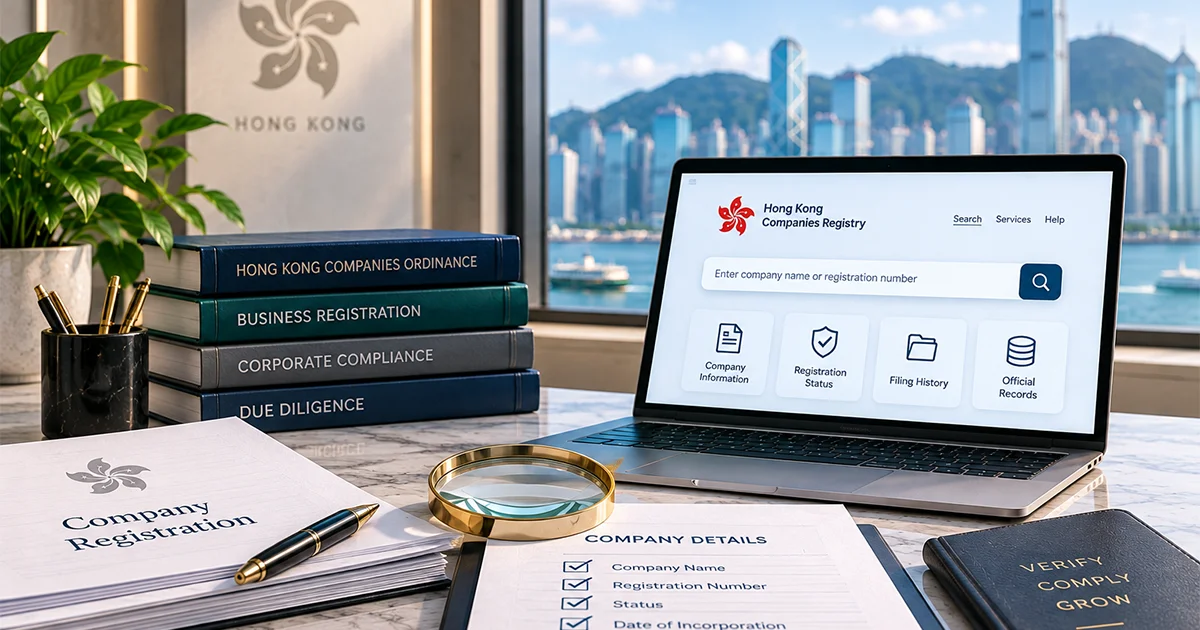
When learning how to search business registration records, the key is to use the appropriate technique based on the information you have at hand. When you know the business name, it will likely be more about locating and verifying the company registration information. If you only have a number, you will want to verify if it is the company name and status as listed with the government.
The correct legal business name is the preferred starting point: not the trading name. Small differences matter. Results will be impacted when there are limited words, abbreviations, spaces, and/or punctuation. The Chinese name will sometimes be translated to English, so a search based on the Chinese name will be more accurate than a search based on the English translation.
After finding the matching record, compare the details of the company to those provided to you. This means the legal name, status, and any other information that is applicable to the purpose. That could be sufficient if you are looking at a supplier. In cases of contracts, shareholding transactions, or regulated transactions, a more detailed examination of the company record and filings may be necessary.
Common problems businesses run into
The most frequently occurring problem is the wrong number being used as an identifier. Businesses tend to replicate information from old invoices, website footers, or email signatures without verifying that the information is up-to-date with the company’s record.
The other issue is having a name that is similar, but not the same, to the name that you are searching. There may be some similar names, and a slight change in a name could result in something entirely different. This can be particularly dangerous during payments, service contracts, or for auditing.
Then there’s the timing. When a new name is adopted for a company or its officers, or its status has changed, there may be a delay in the internal records compared to the official records. This may result in some discrepancy between the various files, such as accounting, company secretarial and tax.
Then there’s the administrative challenge of disjointed government. There are very few SMEs with one individual managing incorporation records, bookkeeping, tax, and statutory compliance. Accordingly, a discrepancy identified in finance might not be remedied in the company’s records of secretaries, and vice versa.
Why accuracy matters beyond basic verification
A registration number search is not only about checking whether a company exists. It supports cleaner operations across several areas of the business.
For accounting, it helps ensure supplier and customer records are correctly maintained. That reduces the chance of duplicate records, payment errors, or supporting documents that do not stand up well during an audit.
For compliance, it helps maintain accurate statutory and administrative records. Your own company documentation may be inconsistent in uses of different identifiers that can lead to delays when you’re working with banks, service providers or government-related paperwork.
For risk management, it provides you with a higher level of awareness prior to entering commercial relationships. It is not a replacement for due diligence but it is a good initial control. In many cases, a straightforward verification procedure can catch any discrepancies in a timely manner, before they become expensive and time-consuming to fix.
Hong Kong company registration number search for new incorporations
Knowing this search process can be helpful if you are in the midst of creating a new company. Founders tend to put emphasis on the company name, share structure, and launch time, but record accuracy is equally important once the company is incorporated.
Core information for your business will be used in multiple incorporation papers, business registration paperwork, bank applications, accounting software, invoices, and tax filing. Various entries can make clean-up quite a chore.
This is partly why you can find lots of companies that prefer to outsource incorporation and company secretarial support along with accounting administration to a single firm. If the functions are in the same location, there is less room for inconsistency and fewer checks back and forth for each record.
When a simple search is enough, and when it is not
Sometimes all you need is a simple verification. When you want to check if a company name is similar to its registration information for invoicing and onboarding, a simple search may suffice.
However, there are instances when it is enough to simply search, and that is just the beginning. If you are thinking of evaluating a new business partner, acquiring a company, checking a director change or for legal, tax or audit reasons, more in-depth investigations may be needed. This will be based on the level of risk, the value of the deal, and how the information is used.
It’s a compromise. It is quicker to do the minimum, but a lack of thoroughness can lead to bigger problems down the road. Some supplier invoices, however, do not necessitate a complete due process. The prudent way to do this is to compare the level of checking with the business decision.
Keeping your own records ready for checking
There is another side to this. Your company information is likely to be verified by other companies, banks, and service providers. If your registration number, legal name, and supporting records are not presented in a consistent manner, this can slow down onboarding, cause questions about your business during due diligence and make your business look less organised than it actually is.
The company identifier should be uniform throughout the statutory documents, accounts files, tax correspondence and commercial documents in a well-maintained record set. This isn’t an article of glamour; it helps to facilitate smooth functioning and creates a lot of confidence among counterparties dealing with you.
If your business would prefer not to have a compliance team within your walls, outsourcing can help you make this more manageable. For instance, Gee Kay Systems & Accounting Limited often assists its clients in maintaining incorporation records, bookkeeping, and continual compliance in sync; otherwise, regular checks can become an ever-present distraction.
While a Hong Kong company registration number search may seem like a minor paper exercise, it’s the core of effective business housekeeping. With accurate records and properly verified companies, decisions are quicker and less surprising.
FAQs
What is the Hong Kong Company Registration Number?
An identifier associated with company registered under the Hong Kong Companies Registry.
Is the company registration number the same as the business registration number?
No. There are different records or authorities associated with them. That is why it is important to be sure that you understand which one a document or an organization requires.
When should I check a company’s registration details?
They could need to be reviewed at various times during supplier and customer onboarding, for accounting reasons, while reading or reviewing contracts, or to ensure compliance.
What information should I check against a company record?
First, verify the exact legal name and registration information against contracts, invoices, banking records, or other contracts.
Is a company registration search enough for due diligence?
Not always. Only a basic search can confirm key registration information, and more comprehensive searches and review of other filings may be necessary for higher-risk transactions or business relationships.