



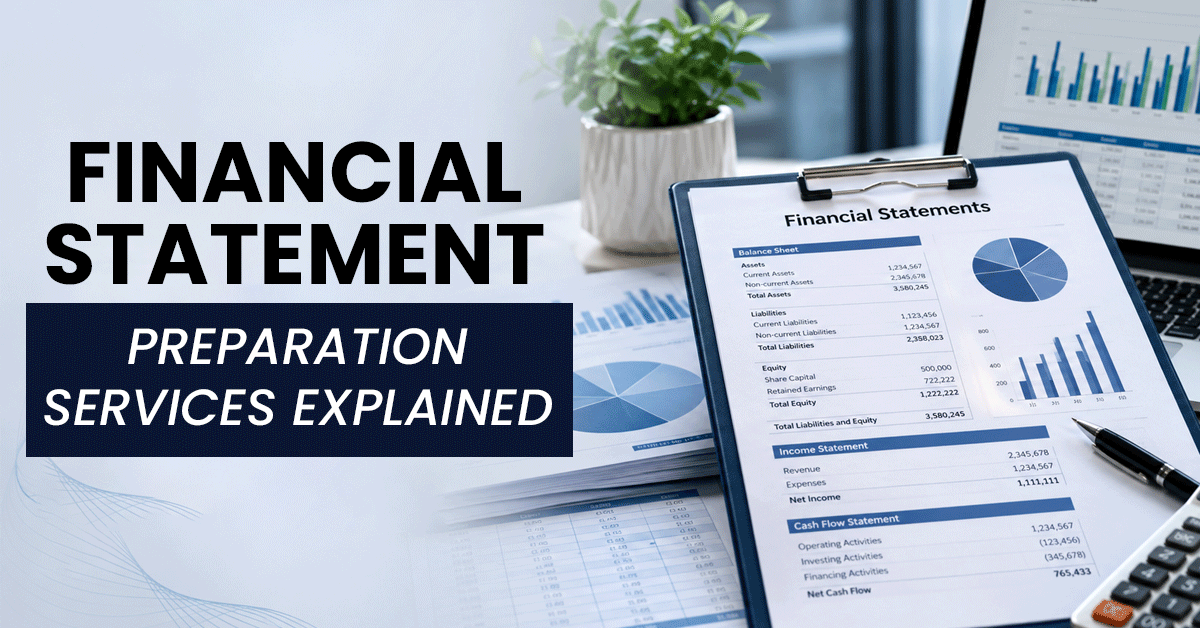
When year-end approaches and records are spread across invoices, bank entries, payroll figures and expense claims, financial statement preparation services stop a routine obligation from becoming a distraction. Founders and SMEs know the true benefit is not only to make statements on time. It is the availability of clear and reliable financial information to facilitate compliance, planning and day-to-day business decisions.
What financial statement preparation services actually cover
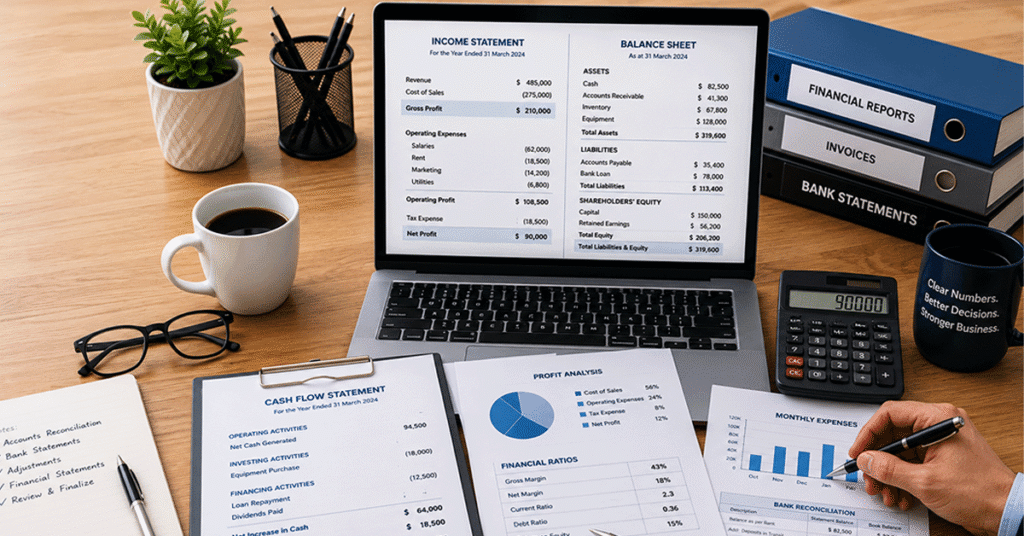
Many business owners assume financial statements are simply a final set of reports produced after bookkeeping is complete. In practice, proper preparation starts much earlier. It depends on orderly records, correct classifications, reconciled balances and a clear view of what the numbers are meant to show.
Financial statement preparation begins with accurate bookkeeping, which is why our bookkeeping services help businesses maintain reliable financial records throughout the year. Depending on the business, that may also involve accruals, prepayments, depreciation, directors’ balances, intercompany transactions and year-end adjustments.
This matters because a set of financial statements is only as reliable as the records behind it. If bookkeeping has been inconsistent through the year, preparation work becomes slower, more expensive and more prone to revision. If the underlying records are strong, the process is more efficient and the resulting statements are far more useful.
Why growing businesses often need support
Small businesses are likely to maintain accounts for a long time with internal management. That can work for a brief period of time, particularly with low transactions. However, as a business starts to expand, trade internationally, work with a range of suppliers or experience reduced cash flow, the finance department will not be as forgiving.
The issue is not just workload. It is technical judgement. Small errors in classification, timing or treatment may seem minor month to month, but they can distort the year-end picture. Revenue may be recognised in the wrong period, liabilities may be understated, or expenses may be recorded without enough support. These are common problems for businesses trying to handle financial reporting in spare time.
Many companies also rely on small business accounting Hong Kong services to maintain accurate records throughout the year, making financial statement preparation faster and more reliable.
Using external support brings structure. It gives management a clearer timeline, reduces the chance of missed items and creates a more consistent reporting process. That is especially valuable for owners who would rather spend time on customers, staffing and growth than on adjusting ledgers and reviewing schedules.
The business value goes beyond compliance
Formal reporting requirements are met with a well-prepared set of statements, but that is by no means limited to the functional aspect. Financial information is the basis for the analysis of stability and direction by lenders, investors, business partners, and all internal decision-makers. Furthermore, accurate financial statements facilitate tax compliance services Hong Kong, which significantly simplify tax filing and compliance needs, preventing needless tax compliance issues.
If the figures are late, unclear or inconsistent, decisions become slower and less confident. If they are accurate and well presented, management can spot trends earlier. Margins, overheads, cash pressure and working capital issues become easier to understand. That makes it easier to decide whether to expand, reduce costs, change pricing or delay a new commitment.
There is also a governance benefit. When financial reporting is treated seriously, it creates better discipline across the business. Records are maintained more carefully, supporting documents are easier to retrieve and responsibility is clearer. Over time, that lowers operational friction.
What to expect from a reliable provider
Not all providers offer the same level of service. Some simply compile figures from whatever records are handed over. Others review the numbers properly, raise questions, identify gaps and help bring the accounts into a usable state. For most SMEs, the second approach is far more valuable.
A dependable provider should start by understanding the business model. A trading company, a consultancy, an e-commerce business and a group with offshore elements will not all require the same treatment. The reporting work should reflect how money actually moves through the business.
Communication also matters. Business owners need explanations in plain language, not technical shorthand. If the adjustments are needed, the rationale should be apparent. If records are missing, the provider should describe what is missing, what can be estimated, and where further management intervention is required. Good service eliminates confusion, doesn’t create more of it.
For companies operating in Hong Kong, local requirements and deadlines make this especially relevant. Financial reporting should fit into the wider cycle of bookkeeping, tax filing and annual company obligations rather than being treated as an isolated task.
Common issues that delay financial statement preparation services
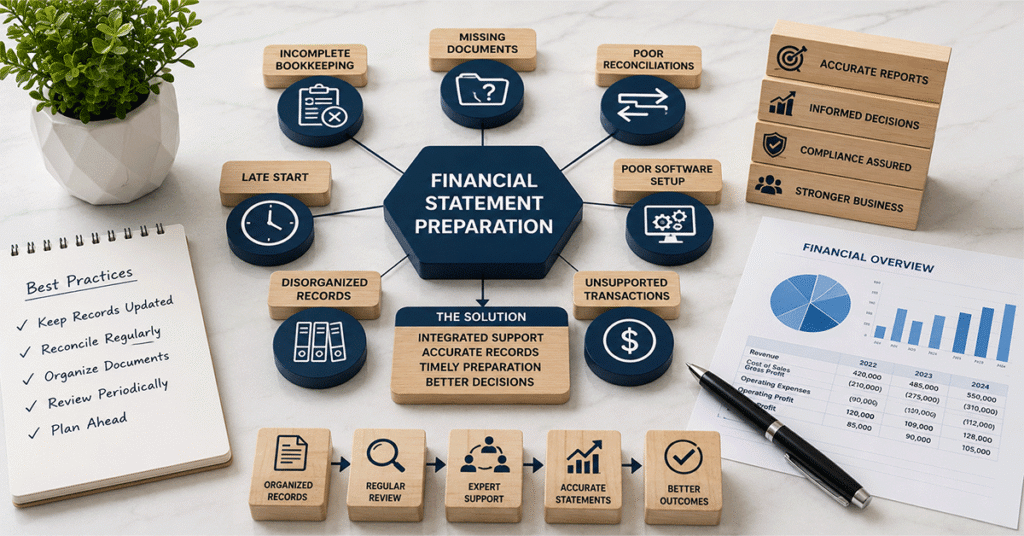
The preparation process tends to slow down for the same reasons again and again. Incomplete bookkeeping is one of the most common. When transactions have not been posted consistently or bank accounts have not been reconciled, the year-end work becomes an exercise in reconstruction.
Poor document management is another problem. Missing invoices, unclear expense support and untracked director payments create uncertainty that has to be resolved before the statements can be finalised. The longer these matters are left, the harder they are to fix accurately.
Then there is timing. Some businesses only start thinking about financial statements when a deadline is close. That creates pressure and limits the chance to review the figures properly. A better approach is to maintain records throughout the year and treat preparation as part of an ongoing finance process.
Software can help, but only if it is being used properly. Businesses using TallyPrime accounting software can streamline bookkeeping and financial reporting, but accurate financial statements still depend on proper data entry, reconciliations, and regular reviews. Accounting systems improve efficiency, yet they do not correct poor judgement or incomplete inputs. A business can have modern software and still produce unreliable figures if the setup, chart of accounts or posting discipline is weak.
How integrated support makes the process easier
For many SMEs, financial statements are only one part of a wider administrative burden. The company records, bookkeeping, tax issues, payroll assistance and filing tax documents are usually held by different people or different providers. This division can cause redundancy, delays and misinformation.
Businesses can further improve reporting accuracy by combining financial statement preparation with outsourced accounts payable management, ensuring supplier transactions are recorded correctly and on time.
An integrated service model solves a lot of that friction. When the same provider understands the company structure, maintains the books and supports annual compliance, financial statement preparation becomes more straightforward. Combining bookkeeping services Hong Kong with financial statement preparation ensures that businesses keep their records up to date and makes it easier to prepare their financial statements at the end of the year. Answers are answered more quickly, records are more readily verifiable, and fewer problems slip through the cracks.
This is where a long-term support program is better than a single year-end support. A provider who is involved in the business year-round can detect issues early, provide record-keeping, and minimize last-minute changes. That saves time, but it also improves confidence in the final output.
Gee Kay Systems & Accounting Limited follows this practical approach by supporting businesses across accounting, company maintenance and compliance needs under one service relationship. For owners who want a single point of accountability, that model can remove a great deal of avoidable complexity.
Choosing the right level of service for your business
The right service depends on the condition of your records, the size of your operation and how much internal finance capability you already have. A small company with clean bookkeeping may only need year-end preparation and review. A growing business with multiple revenue streams may need monthly support, reconciliations and periodic management reporting to keep the year-end process under control.
International businesses should be even more careful. The cross-border transactions, foreign currency balances and group relationships may need more attention. Simple on the surface can quickly get complicated if the records are not organized properly in the beginning.
Cost is important, but it’s not the only factor. Time lost by management in not solving the errors, or in the need for follow-up, can actually cost more than the savings from a low-cost service. Sometimes it is more worthwhile to offer a more complete service and avoid rework and risk.
What business owners can do to make preparation smoother
Even with external support, management still plays an important role. Making good records, tidy paperwork and prompt answers to questions are of great value. If the finance provider raises a point about an unusual payment, a balance that is related to the contract or an outstanding invoice, clarify those items ASAP to keep things going.
Reviewing financial data on a regular basis is also a good idea, rather than waiting for year-end. Regularly checking month after month and/or quarter after quarter will help identify the discrepancies in time before they become larger issues. This is not to say that owners have to be accountants, but they should know the difference. Essentially, it’s simply using financial reporting as a management tool and not just as an annual duty.
Best results tend to be achieved with ongoing smooth operations, not a frenzy at year’s end. Financial statements that are not only compliant, but useful, are created through a combination of accurate bookkeeping, clear processes, and experienced preparation. And when your numbers are dependable, running the business becomes a little less uncertain and a lot more manageable.
If you’d like professional support with financial statement preparation, bookkeeping, or compliance, get in touch with our team to discuss the right solution for your business.
FAQs
1. What are financial statement preparation services?
They include the review of accounting records, year end adjustments and creating accurate financial statements for compliance and business reporting.
2. Why are financial statements important for small businesses?
They assist business owners in monitoring performance, complying with regulations, obtaining financing, and making sound financial decisions.
3. How often should financial statements be prepared?
They are usually prepared on a yearly basis for statutory reporting obligations and some will also create monthly or quarterly statements for more effective financial management.
4. Can accounting software replace financial statement preparation services?
While accounting software can be used to record transactions, a professional review is still required to ensure transactions are accurate, compliant, and they get adjusted for the close of the year.
5. How can outsourced financial statement preparation benefit my business?
It saves some time, minimises reporting errors, enhances compliance, and ensures accurate financial information for business planning and growth.
Benefits of Outsourced Accounting Services for Businesses
Company Secretary Service Hong Kong Guide
Deregister Company in Hong Kong Step by Step