



A promising business idea can lose momentum over a missing address, an inconsistent spelling of a director’s name, or an ownership structure that has not been clearly recorded. The essential documents for company incorporation are not simply forms to complete. They create the legal record of who owns, controls and represents the company from day one.
For founders forming a Hong Kong private limited company, preparation makes the process more predictable. It also avoids unnecessary changes, delays and confusion when opening a business bank account, hiring service providers or in future statutory responsibilities. The exact documentation will vary depending on whether the owners are individuals or companies and whether they are local or foreign. But the fundamentals are simple when they are structured properly.
Why incorporation documents deserve careful attention
A company is considered to be a separate legal entity when incorporated. While that may help to keep business and personal matters separate, it also brings with it formal obligations. This information should be clear and concise for the Companies Registry so they can obtain the necessary information about the proposed company, its officers, shareholders and share structure.
A document submitted at formation often becomes the starting point for later records. If a founder’s residential address, passport details or shareholding percentage is entered incorrectly, correcting it later adds administration and may affect compliance records. A well-prepared application therefore saves more than time at the outset. It gives the business a reliable administrative foundation.
Essential documents for company incorporation in Hong Kong
A Hong Kong private company is generally incorporated through an electronic or paper application containing prescribed company details. The following documents and supporting records are central to a complete application.
The incorporation form
The incorporation form for a company limited by shares records the proposed company name, registered office address, business nature, share capital and the details of its first directors, company secretary and shareholders. It also identifies the founder member or members and confirms their agreement to form the company.
Accuracy matters here. Names should match identity documents exactly, including the order of names where relevant. The proposed registered office must be a physical Hong Kong address, not merely a post office box. It is the official address for statutory communications and records, so founders should ensure it will be properly managed from the beginning.
The form also states the initial share structure. Many new companies begin with a simple arrangement, such as one shareholder holding all ordinary shares. Where ownership is divided between co-founders, the number of shares and allocation should reflect the agreement reached before submission. Changing ownership later is possible, but it should not be used as a substitute for deciding the basics early.
Articles of Association
The Articles of Association are the company’s internal rulebook. They set out how decisions are made, how shares may be issued or transferred, the powers of directors and the procedures for meetings and resolutions.
A company may adopt standard articles suitable for a straightforward owner-managed business. This is often practical for a sole founder or a small team with a simple shareholding arrangement. A bespoke version may be more appropriate where there are different share classes, investor rights, restrictions on transfers or detailed founder arrangements.
Articles do not replace a shareholders’ agreement. Where multiple parties are involved in the formation of a business, they might also require a separate agreement regarding decision-making powers, investment contributions, exit or conflict resolution. It’s a business decision, but it’s simpler to resolve it before incorporation than after.
Identity and address evidence for key people
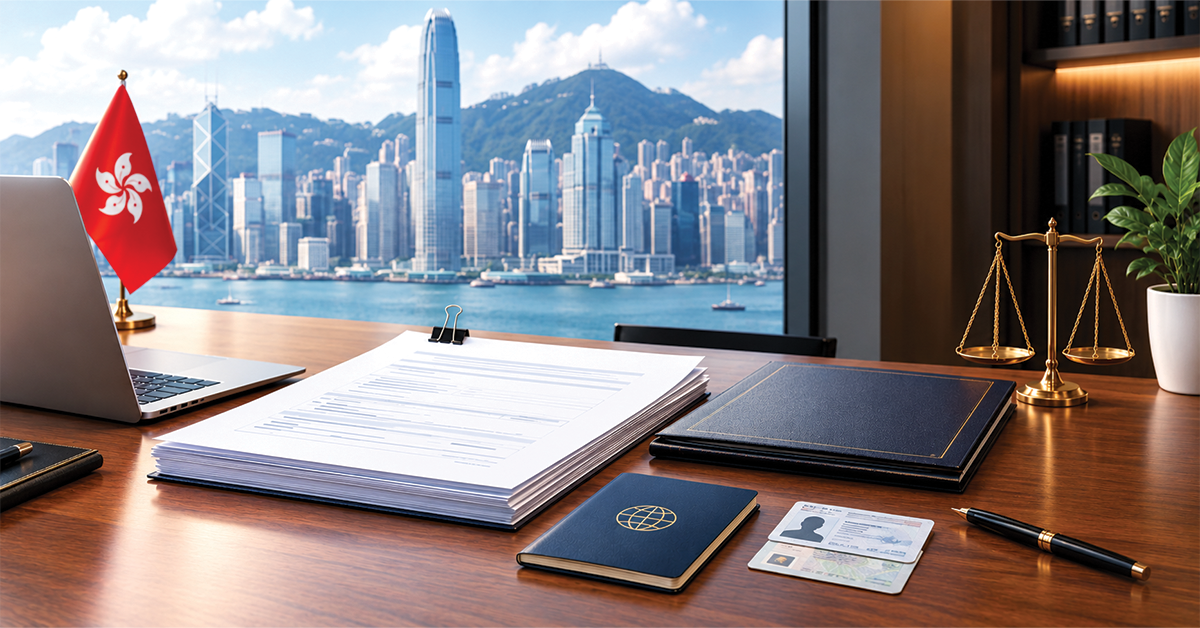
Directors, shareholders and beneficial owners will normally need to provide identity verification and proof of their usual residential address. For an individual, this commonly includes a clear copy of a valid passport or Hong Kong identity card, together with recent address evidence such as a bank statement or utility bill.
Service providers may request additional information to understand the proposed business and ownership structure. This is particularly common where an owner lives overseas, holds citizenship in more than one jurisdiction, or is connected to a corporate shareholder. The objective is to establish a clear and credible record of the people behind the company.
Documents should be current, legible and consistent. A common issue is an address document showing an abbreviated name while the passport shows a full legal name. It may be acceptable with supporting explanation, but it is better to identify and resolve differences before filing.
Details of directors, shareholders and the company secretary
A Hong Kong private company must have at least one natural-person director. Directors may live anywhere, but each person’s details must be recorded accurately. A company can have corporate directors in some circumstances, although it must still meet the requirement for at least one individual director.
The company also needs a company secretary. If the secretary is an individual, that person must ordinarily reside in Hong Kong. If it is a corporate service provider, it must have an appropriate Hong Kong presence. The sole director cannot act as company secretary where they are also the sole shareholder.
Shareholder details are equally important because they establish legal ownership. Founders should distinguish between a shareholder, who holds shares, and a beneficial owner, who ultimately owns or controls the business. In a simple company these may be the same person. In a group or nominee arrangement, they may not be.
Registered office information
All companies are required to have a registered office in Hong Kong. This address is used for official notices or statutory records and formal correspondence. It is not necessarily the place where the business trades or meets clients.
For overseas founders and lean start-ups, using a professional registered office and company secretarial service can reduce the risk of missed notices. It also provides a more stable solution when the business operates remotely or changes working locations. The key consideration is not prestige but dependable handling of official correspondence and records.
Business registration information
Company incorporation and business registration are generally handled together for a new Hong Kong company. Founders must describe the nature of the intended business activity. This description should be accurate and sufficiently specific without making unnecessary claims about services the company does not yet provide.
For example, an online trading business, a consulting firm and a software development business each have different operating descriptions. If the company later expands into a new area, its business particulars can be updated as needed. At formation, clarity is more useful than trying to predict every possible future revenue stream.
When a shareholder is another company
Corporate ownership adds a layer of documentation because the company applying to become a shareholder must show that it exists and has authorised the investment. Requirements vary by jurisdiction and structure, but the supporting pack commonly includes:
- its certificate of incorporation or equivalent registration record;
- its constitutional documents;
- a current register or official record showing directors and shareholders;
- a board resolution approving the Hong Kong investment and appointing an authorised signatory; and
- identity and address evidence for the people who ultimately control the corporate shareholder.
Documents issued outside Hong Kong may need certification or further verification, depending on where they originate and the requirements of the receiving party. This is one area where early review is valuable. A multi-layer ownership structure can be entirely legitimate, but it should be presented in a way that makes the chain of ownership easy to understand.
Records to prepare immediately after incorporation
Receiving the incorporation documents is the beginning of the company’s administrative life, not the end of it. The company should maintain statutory registers, records of directors and shareholders, and details of persons with significant control where required. It should also keep proper accounting records that explain its transactions and financial position.
Founders should retain the incorporation form, Articles of Association, business registration record, ownership documents and key resolutions in one secure location. Digital copies are useful, but access should be controlled and the original source documents preserved where applicable. These records are frequently requested when dealing with banks, investors, counterparties and professional advisers.
The company should also establish a practical routine for recording income, expenses, invoices and payments from its first transaction. Delaying this work until a statutory deadline approaches creates pressure and makes financial reporting more difficult than it needs to be. Incorporation, company secretarial support and ongoing bookkeeping work best as connected functions rather than separate administrative tasks.
Avoid the common document mistakes
Most incorporation delays are caused by small, preventable gaps. The company name may be unavailable or too similar to an existing name. An identity copy may be blurred, expired or incomplete. A registered office may be entered without a reliable arrangement for receiving official correspondence. In other cases, founders have agreed commercially on ownership but have not translated that agreement into the share allocation shown on the application.
International founders should allow extra time for document collection, address verification and any certification needed for overseas records. They should also avoid assuming that an incorporation certificate alone settles every operational requirement. Checks are required for bank onboarding, contractual arrangements, and continuous compliance.
Gee Kay Systems & Accounting Limited can help founders bring these documents together and navigate the step-by-step incorporation process accurately. This is followed by the company secretarial and accounting support they need. The practical goal is simple. It establish the company with records that are clear today and remain dependable as the business grows.
FAQs
1. What documents required to incorporate a company in Hong Kong?
These include the incorporation form, Articles of Association, registered office information, director and shareholder information and identity and address proof.
2. Do overseas founders need additional documents for Hong Kong company incorporation?
Additional ID, address and verification documents might be required for overseas founders. Incorporation records, constitutions and board resolutions may be required for the corporate shareholders.
3. Is a registered office required for a Hong Kong company?
Yes. All Hong Kong companies are required to have a registered office in Hong Kong for handling postal and official correspondence as well as statutory records.
4. What documents should be kept after company incorporation?
The company should keep its incorporation documents, Articles of Association, business registration record, ownership records and statutory registers and relevant resolutions in a safe and usable place.
5. Can a company secretary help with the incorporation process?
Yes. A company secretary or professional firm can help with the preparation of incorporation and other company secretarial duties.