



A missed filing deadline can create a problem long after the original paperwork has been forgotten. For founders, company secretarial services provide the practical structure needed to keep a Hong Kong company in good standing while management concentrates on customers, cash flow, and growth.
This work is often mistaken for basic administration. It’s actually where business records, business decisions, and statutory filings converge in the company. Changing directors, shareholders, or a company’s registered address may seem simple enough. But it requires proper documentation and reporting in the right time frame. Reliable support helps prevent small administrative changes from becoming expensive distractions.
What company secretarial services cover
Every Hong Kong limited company must appoint a company secretary. The secretary must be a Hong Kong resident individual or a corporate service provider with a presence in Hong Kong. A sole director cannot also act as the Hong Kong company secretary.
The role is not about running the business or making decisions for directors. It is about helping the company to meet its legal obligations and to keep a proper company record. For many SMEs, this is a more viable way to operate than hiring and training an in-house person to perform a specialised, time-constrained and ever-changing task.
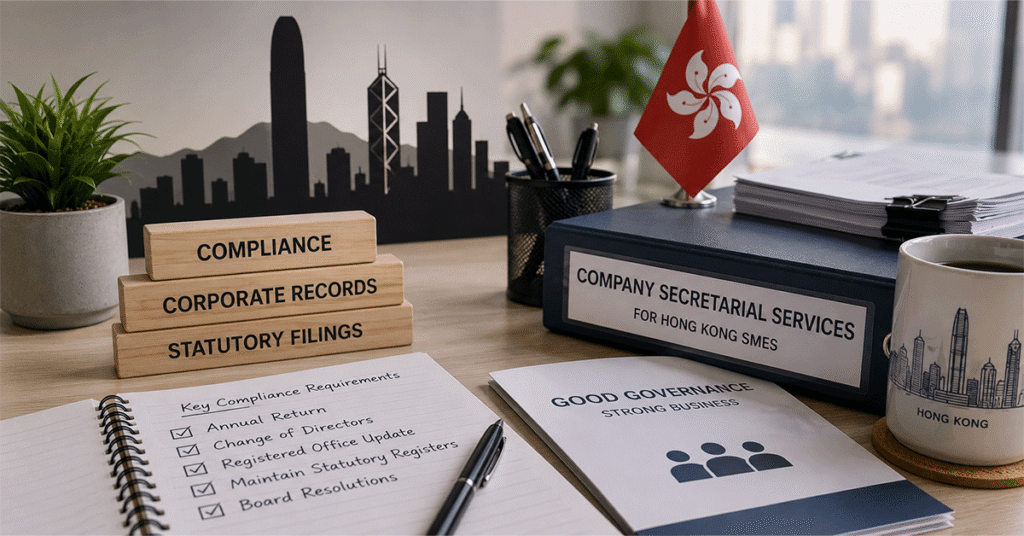
Generally, this is the scope of the services carried out, which involve holding the statutory registers, preparing and filing the annual return, keeping an eye on key due dates and dealing with changes in company particulars. It may also include preparing board resolutions, supporting share transfers or allotments, arranging updates to the registered office, and keeping records of directors, shareholders and company officers current. This includes keeping the register of directors accurate and up to date, and ensuring resignations or changes are properly recorded and maintained in line with Hong Kong Companies Registry requirements.
The exact scope should match the company’s activity. A newly incorporated business with one shareholder has different needs from an established trading company with several directors, overseas investors and regular ownership changes. The value lies in having the right level of support before a transaction or deadline demands it. Businesses that need ongoing compliance support can benefit from our Hong Kong company secretary service, which is designed to help SMEs meet their statutory obligations efficiently.
Why accurate records matter to growing businesses
Corporate records are much more than records to file. They indicate who is permitted to represent the company, who owns the company, and how major decisions were made. When these records are incomplete or inconsistent, practical difficulties can follow.
For example, a bank may request evidence of a director’s appointment or a current ownership structure. A potential investor may need to review share allotments and resolutions before proceeding. A change of address may require related correspondence and company records to be updated. If the underlying documents are not in order, management must spend time recreating decisions and correcting filings when they should be moving the business forward.
Company secretarial support creates a clear record from the start. This is especially important for businesses that wish to raise capital and restructure the shareholders’ interests or enter new markets. Good governance does not have to be complicated; it must be consistent.
For companies with frequent ownership changes, working alongside a share registrar Hong Kong service can help ensure shareholder information, share transfers and allotments are accurately recorded and aligned with statutory records.
The annual return is only one part of the picture
Many company owners know that an annual return must be filed, yet annual maintenance is broader than one yearly task. Directors remain responsible for ensuring the information held about the company is accurate throughout the year.
A comprehensive annual company maintenance service helps ensure these ongoing obligations are managed consistently rather than only at annual filing time.
The relevant changes may refer to the change of company secretary, registered office or director, transfer of shareholders, allotment of shares and increase in share capital. They are frequently accompanied by paperwork and other requirements that must be filed. Leaving them until the annual return is due can create inconsistencies and unnecessary pressure.
A proactive provider maintains a schedule, inquires about the changes, and makes the necessary paperwork adjustments to ensure that documents are updated appropriately. It’s a more reliable way of doing things than to wait until a reminder to comply is issued.
The benefit of one point of accountability
Founders commonly work with separate parties for incorporation, bookkeeping, tax matters and company administration. That can work, but it also creates gaps. One adviser may assume another has updated an address, recorded a share issue or retained a resolution. The business owner is then left to coordinate the details.
Combining company secretarial work with broader corporate compliance services, HK allows businesses to manage statutory obligations through a single, coordinated support team. Using an integrated professional support team can reduce that risk. When company secretarial work sits alongside accounting and ongoing compliance administration, information can be checked in context. A shareholding change, for instance, may affect company records, financial documentation and future reporting requirements. Seeing the wider picture helps avoid duplicated requests and conflicting information.
This does not mean every business needs the most extensive service package. A dormant company may require straightforward annual maintenance, while an active SME may benefit from regular access to support as its operations change. The right arrangement is the one that gives directors confidence that routine obligations are covered without paying for services they do not use.
Choosing a company secretary: what to look for
The company secretary is named in the company’s public records, so the appointment deserves more consideration than a low-cost filing service. The cost is important, but it should not be the sole consideration. Some delays, lack of communication, and incomplete documentation may be more expensive than the initial saving.
Try to find one that simplifies the responsibilities and tells you what the annual fee covers. It is important to be aware of whether the service includes the preparation of annual returns, registration of statutory registers, preparation of standard resolutions, registered office support and advice regarding common company changes. It is also worth asking how urgent requests are handled and whether there are separate charges for more complex transactions.
Experience with Hong Kong companies is important, especially for international owners who may not be familiar with local requirements. A capable provider should be able to explain which information is needed, when directors need to act and what must be retained for the company’s records. They should not make it too technical to comply; but they should not be neglectful of the details.
Questions to settle before you sign
When choosing a provider, ask about your point of contact, how deadlines are tracked and the process for escalation if you need a change that must happen immediately in your corporation. Ensure that original documents and digital records are stored correctly and that the provider will let you know of information that needs to be updated.
It is equally important to understand your own role. Outsourcing company secretarial work does not transfer directors’ responsibilities. Directors still need to provide timely and accurate information, approve resolutions where required and inform the provider when the company makes a material change. The strongest arrangement is a clear partnership: the provider manages process and documentation, while directors make informed decisions promptly.
Depending on your company’s circumstances, you may also need guidance on appointing a designated representative to satisfy Hong Kong’s regulatory requirements.
Common situations where support makes a difference

Company secretarial assistance becomes particularly valuable at moments of change. A founder may add a business partner and issue new shares. An overseas parent company may appoint a local director. A growing company may move premises, change its registered office or revise its ownership structure before seeking investment.
Each situation calls for more than an informal agreement by email. The company needs the appropriate approvals, records and filings to reflect what has happened. The timing of the transaction and paperwork may vary depending upon the transaction, and it is generally more efficient to get the advice early than to correct the position later.
The same principle applies to businesses that have been operating quietly for several years. If registers have not been reviewed, correspondence has gone to an old address or changes were agreed without formal documentation, a professional review can identify what needs attention. Addressing issues early is normally simpler than dealing with them when a bank, investor or regulator requests information.
Building compliance into everyday operations
The best time to organise company records is not just before a statutory deadline. Build a simple habit into management procedures: notify your company secretary whenever directors, shareholders, addresses or share capital may change. Keep signed resolutions and relevant communications together, and avoid assuming that a commercial agreement automatically updates the company’s legal position.
Gee Kay Systems & Accounting Limited supports businesses that want this work handled with clarity and continuity. Having company administration and financial support in a single professional relationship can help business owners save time by running after paperwork and make better decisions with confidence.
Keeping an up-to-date company record is a silent indication of a sound business. Provide appropriate support from the start, maintain communication when changes take place, and do not make compliance an ‘everyday headache’.
For some practical advice and continued support, get in touch with our team to ask about the support level we can offer the company secretary role.
FAQs
1. Is a company secretary mandatory for every Hong Kong company?
Yes, all Hong Kong limited companies are required to have a company secretary who provides business skills.
2. What does a company secretary do in Hong Kong?
A company secretary keeps the company’s statutory records and handles filings. Also, helps keep the company compliant.
3. Why should SMEs outsource company secretarial services?
An outsourcing service offers professional compliance help and eliminates administrative load and erroneous filings that can end up costing you more.
4. What company changes need to be reported in Hong Kong?
Restructuring the Directors or Shareholders, the company’s registered office, share capital, or company secretary generally requires proper documentation and filing.
5. How can professional company secretarial services benefit a growing business?
They can ensure proper corporate record-keeping, meet regulatory requirements, and enable successful business expansion and investment readiness.