



A profitable year is good news until the tax return arrives and the questions start. At first glance, profits tax Hong Kong rules may appear simple, but they’re not if you don’t know where the profits are coming from, where they’re being generated, or what you’re claiming as your treatment.
Business tax is relatively simple in Hong Kong, which makes the city an interesting place for entrepreneurs to do business. Tax compliance services Hong Kong are also very important for many businesses to ensure that they are compliant with Inland Revenue Department requirements, file their taxes on time, and ensure that they are accurate and complete. Simplicity is not automatic, however. Whether you’re a start-up, a trading company, a consultancy, an e-commerce company or a regional office, getting the fundamentals right at the outset can save you time, stress from filing, and even save you money in the future for any corrections that may be required.
What is profits tax in Hong Kong?
Profits tax is the tax charged on profits arising in or derived from Hong Kong from a trade, profession or business carried on in Hong Kong. From a business perspective, it means there is no taxation because of a business’s Hong Kong company. The real question is whether the profits are connected to business activities that produce taxable profits in Hong Kong.
That distinction matters. Many company owners assume incorporation alone decides the tax position. It does not. A Hong Kong company can have taxable profits, non-taxable profits, or a mixture of both, depending on the facts. This is why bookkeeping, contracts, invoices and the flow of operations all matter.
Who needs to pay profits tax in Hong Kong?
Most businesses operating through a company, partnership, sole proprietorship or other business structure should consider whether they are subject to profits tax. If your business is carrying on trade or services and earns profits connected to Hong Kong, you will usually need to file and, where applicable, pay tax.
For limited companies, the Inland Revenue Department typically issues a Profits Tax Return after incorporation and then on a recurring basis. Even if the company has not yet started trading or has made no profit, filing obligations can still arise. A dormant period, a loss-making year, or low business activity does not necessarily remove the need to respond.
Current profits tax rates
Hong Kong uses a two-tier profits tax rates system for corporations and unincorporated businesses, subject to eligibility rules. For corporations, the first portion of assessable profits is taxed at a lower rate, with the remainder taxed at the standard rate. For unincorporated businesses, the rates are different but follow the same broad structure.
For many SMEs, this is favourable, especially in the early growth stage when cash flow needs to be protected. However, not every connected entity can enjoy the lower tier in the same way. If you operate multiple businesses under common control, the group position should be reviewed carefully before assuming each entity qualifies independently.
How taxable profits are worked out
Taxable profits do not always equal the figure shown as net profit in your management accounts. The starting point is usually your accounting profit, but adjustments are then made for tax purposes.
Some expenses may be deductible if they are incurred in producing assessable profits. Others may be disallowed, partly deductible, or require closer review. Capital expenditure, private expenses, and items not wholly related to the business often need adjustment. Income that is not taxable in Hong Kong may also need separate consideration.
This is where accurate records become essential. Effective small business accounting Hong Kong practices ensure financial records remain accurate and make profits tax calculations much easier.
If the numbers in your accounts are incomplete, mixed with personal spending, or unsupported by documents, preparing a reliable tax computation becomes much harder. For growing businesses, this is often the point where outsourced accounting support stops being a convenience and becomes a practical necessity.
The offshore claim question
One of the most misunderstood areas of profits tax in Hong Kong is the offshore claim. Many business owners hear that Hong Kong follows a territorial basis of taxation and immediately assume foreign customers mean no tax. That is too simplistic.
The source of profits is determined by looking at what the business did to earn the profits and where those profit-generating activities took place. For a trading business, this often involves examining where contracts were negotiated and concluded, where suppliers and customers were engaged, and how the transactions were executed. For a service business, the place where services were actually performed is often highly relevant.
An offshore claim can be valid, but it must be supported by facts and documentation. If the commercial substance points to Hong Kong activities generating the profit, the claim may not stand. On the other hand, some international businesses do have a strong case for offshore treatment. The right answer depends on operations, not assumptions.
Filing obligations and deadlines
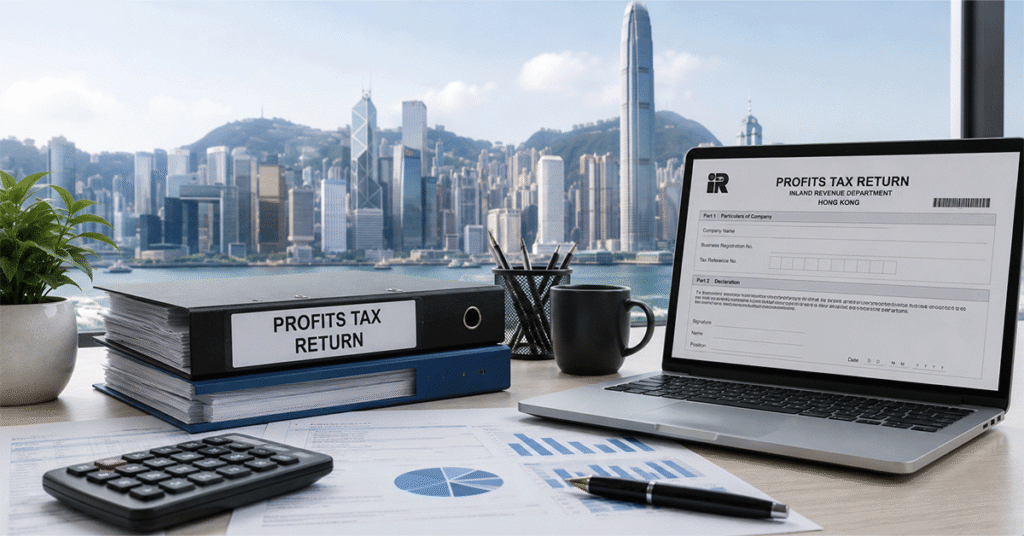
Once a Profits Tax Return is issued, the business must complete and submit it within the deadline stated, unless an extension applies. The return is generally supported by financial statements and tax computations. Businesses can simplify this process with professional audit arrangements and financial reporting support.
For first-time founders, one of the common surprises is timing. A company may be incorporated in one year but receive its first tax return later. That delay does not mean records can wait. From the start of business activity, transactions should be recorded properly so that year-end reporting and tax filing do not turn into a reconstruction exercise.
Late filing may result in fines, further investigation and added stress for management. The quickest and easiest method of minimising that risk is to maintain the books on a regular basis throughout the year, not waiting until the statutory deadlines.
Common mistakes business owners make
The first mistake is treating bookkeeping as an afterthought. If sales, expenses, director payments and reimbursements are not recorded properly, the tax position quickly becomes unclear.
The second is assuming that low profit means low risk. Smaller businesses often believe they will not attract attention, but filing errors, inconsistent returns and unsupported claims create problems regardless of company size. Professional assistance with small business tax filing in Hong Kong helps reduce filing errors and keeps businesses compliant.
The third is confusing cash movement with taxable profit. Money in the bank is not always profit, and a profitable business may still have cash flow pressure. Tax planning requires a proper view of both accounting results and actual payment capacity.
The fourth is relying on generic advice from overseas sources. Hong Kong tax rules are specific, and business owners with cross-border operations need guidance based on their actual structure, contracts and workflow.
Records you should keep
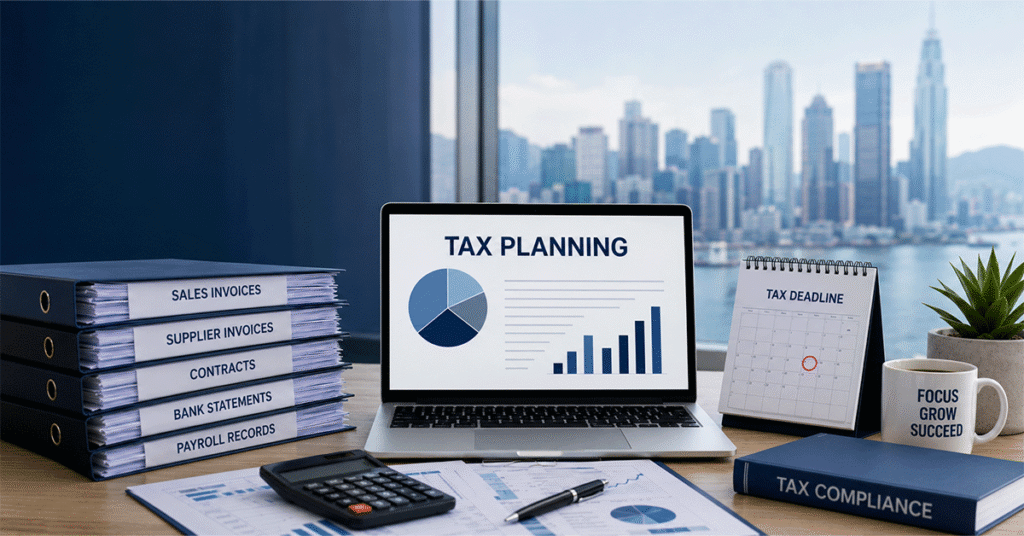
Strong tax compliance starts with disciplined record keeping. Businesses should keep at least sales invoices, supplier invoices, bank statements, contracts, payroll records, and expense receipts and/or documents for significant transactions. If an offshore job is being considered, it’s also advisable to keep correspondence, travel records, shipping documents, and documents that indicate where important business activities were conducted.
Good records are more than a means to a return. Many SMEs rely on solutions like TallyPrime Hong Kong to manage bookkeeping, produce financial reports, and keep accurate accounting records all year round. They make management more aware of margins, control costs and resolve tax queries quickly. This clarity of operations is worth much more for companies looking to scale than just meeting regulatory requirements.
Why early tax planning matters
Tax planning is most useful before year-end, not after. Working with professional tax compliance services in Hong Kong throughout the year helps businesses identify issues early and avoid last-minute filing challenges. Once you have made the transactions and the period closed, your choices become more limited. Throughout the year, it is possible to further refine record structure, clarify business and personal expenses, assess intercompany arrangements, and determine if the current treatment is consistent with actual operations.
It is particularly important for start-ups and SMEs in their rapid growth phase. The tax position could also change if new markets are explored, if staff are recruited, or if the supply chain or contracts are altered, by using overseas workers instead of locally. What works for year one might not be suitable for year three.
Many business owners would prefer to see tax as a standard part of their finances, not a tedious task that needs to be completed at the end of the year. This typically results in improved records, reduced surprises, and increased confidence in the numbers.
Getting support without building an in-house team
Most founders prefer not to spend their time figuring out their tax forms or whether their expenses have been entered properly. They are looking for clear answers, a good process, and trust that deadlines can be met.
This is why outsourced bookkeeping services, financial reporting services, company compliance services, and tax filing services are preferred by many SMEs. Combined, these functions give the business cleaner records and less room for mismatches between daily accounting and year-end reporting. A steady provider can also spot issues early, before they become filing problems.
For businesses that value one point of accountability, this joined-up approach is often more practical than managing separate providers for each task. Gee Kay Systems & Accounting Limited works with founders and established businesses on exactly that basis – simplifying ongoing obligations so management can stay focused on operations.
If you are unsure about your profits tax position, get in touch with our team for tailored advice on your Hong Kong tax obligations. We properly review how your business earns income, where activities take place, and whether your records support the treatment you intend to file. A clear position now is usually far less expensive than fixing an unclear one later.
The right tax outcome starts with facts, not assumptions, and that is always a good foundation for growth. Professional tax compliance services Hong Kong can provide the expertise needed to keep your business compliant while supporting long-term growth.
FAQs
1. What is profits tax in Hong Kong?
Profits tax is charged on profits earned from business activities carried out in or derived from Hong Kong.
2. Do all Hong Kong companies have to file a Profits Tax Return?
Most Hong Kong companies must file a Profits Tax Return when issued by the Inland Revenue Department, even if they made no profit.
3. What records should I keep for profits tax filing?
It’s important that businesses retain their invoices, receipts, bank statements, contracts, payroll records and other financial records.
4. What happens if I miss the Hong Kong profits tax filing deadline?
Late filings incur penalties, further assessments, and can attract IRD interest.
5. Why should SMEs use tax compliance services in Hong Kong?
Professional tax compliance services in Hong Kong help businesses stay compliant, file accurate returns, and avoid costly tax mistakes.