



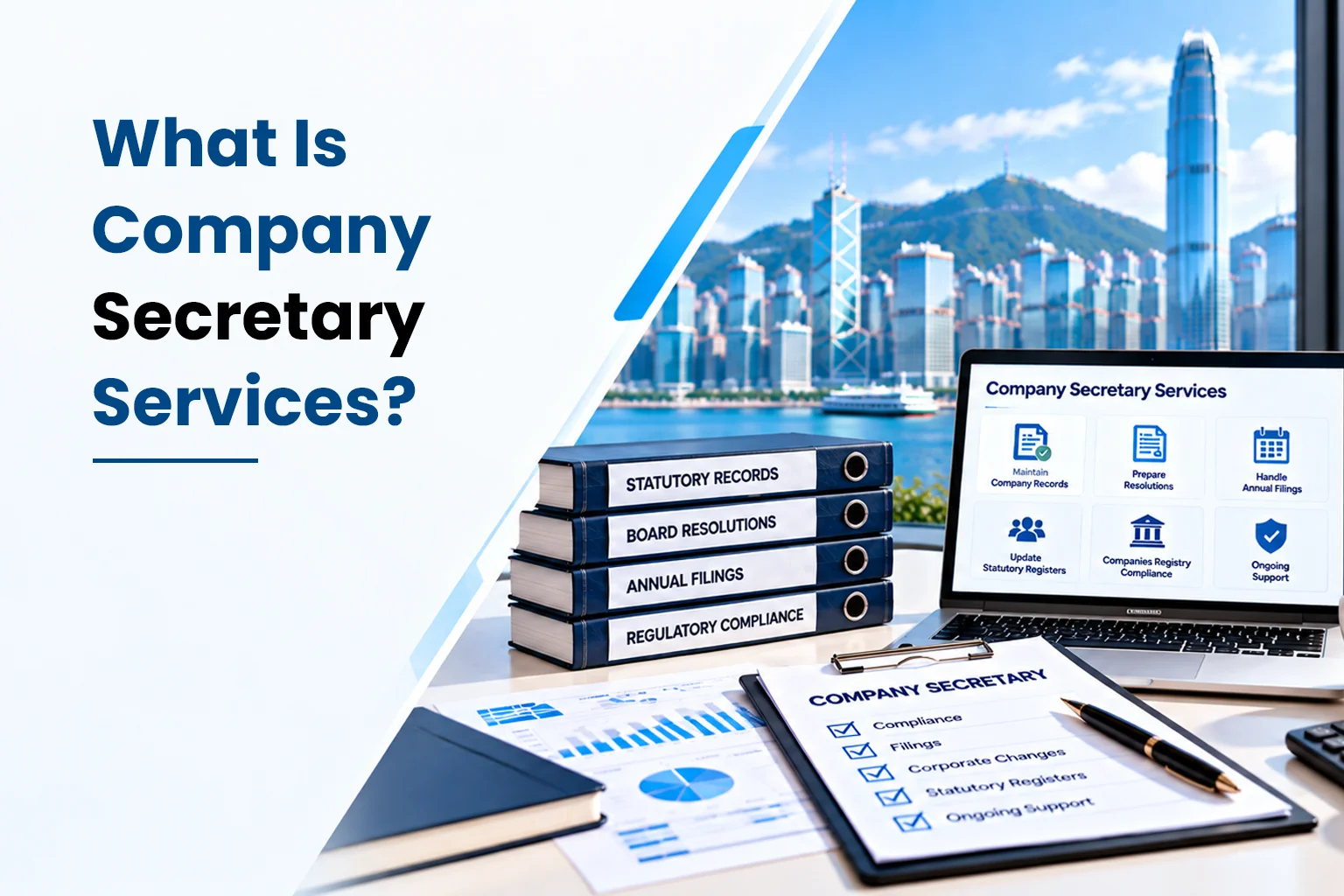
If you poll the majority of founders about what holds them back after they’ve incorporated, the answer will often be not sales or product. It’s the ongoing flow of filings, registers, resolutions, and statutory deadlines that live in the background until something is missed. It’s here that the question, What is company secretary services? becomes more of a business question than a legal one.
In the case of Hong Kong companies, company secretary services are the continuous administrative and compliance assistance provided to ensure that the company fulfills its statutory requirements. Typically involves keeping company registers, creating resolutions, completing annual returns, updating statutory registers, and ensuring that the company complies with Companies Registry obligations. It is not the same as general administration, and it’s not just a formality. It is a formal function that is connected to the manner in which the business is managed and maintained properly.
What is company secretary services in practice?
To put it simply, company secretary services keep a company out of trouble with the law. As for businesses that wish to learn more about company secretary services explained in detail, the role encompasses statutory record-keeping, annual filing, corporate documentation, and changes to company information, among other things. In Hong Kong, all local limited companies are required to have a company secretary, and the requirement applies throughout the company’s life.
The position is frequently misinterpreted, and the term secretary might seem clerical because that is what it is. It’s reality is: The company secretary position is a compliance one. It maintains statutory books, drafts proper corporate documents in relation to the company and the directors’ changes, and ensures the timely and proper filing of the documents.
This can involve maintaining a register of significant controllers, submitting an annual return and noting any variations to the register of shareholders/directors for a new founder. This may include more frequent business interactions with a growing SME, support and coordination of accountants, auditors and tax advisers, and support for governance.
Why company secretary services matter in Hong Kong
While Hong Kong is a great place to start and run a business, doing business here isn’t done half-heartedly. It is a structure that’s easy to follow, and time is crucial. The absence of filing the document or maintaining the register up-to-date or failure to update the register in case of a corporate change can result in penalties, delay or inconveniences to open a bank account, prepare for an audit or respond to any official requests.
This is why many businesses hire to outsource the function. There is something greater than technical correctness in the benefit. It’s also continuity.
This is usually not the kind of issue that founders and small teams want to spend their time on: understanding the filing requirements, writing a resolution, or deciding whether to change the company structure and whether the authorities should be updated.
A good company secretary service alleviates that burden. It establishes a mechanism for obligations that normally are accomplished late, haphazardly, or while under stress. This can be more useful for operators from abroad, as local rules may be unknown and time zones aren’t much assistance in meeting compliance deadlines.
What does a company secretary usually handle?
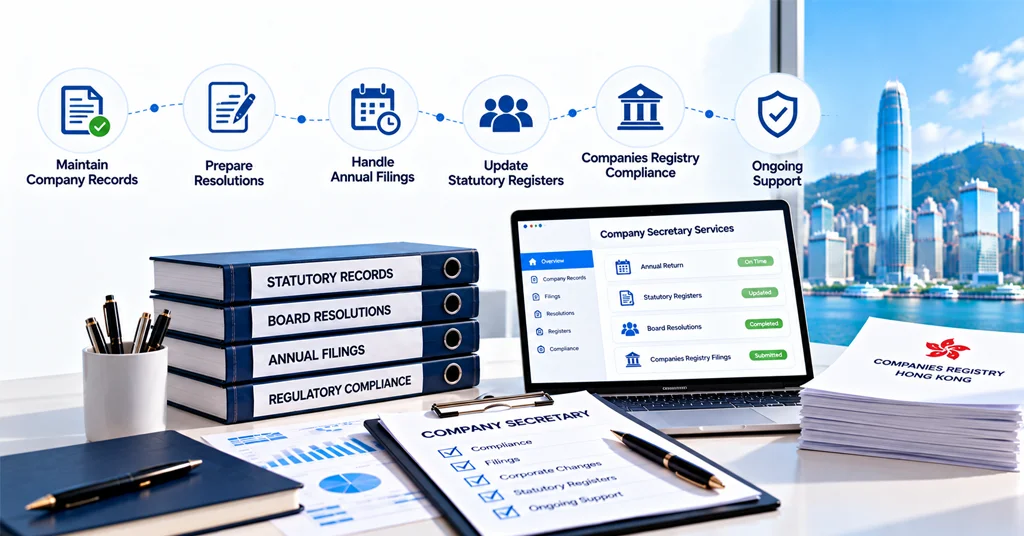
The precise extent of the services provided will vary depending on the provider and from company to company, but the basic duties performed by a company secretary are largely standard. These typically involve the keeping of the company’s statutory books, drafting and filing annual returns, drafting board and shareholder resolutions, recording information on changes to directors, shareholders or registered office information, and ensuring the registers are kept up to date.
Some providers will also incorporate, register a business, register a representative and offer more general annual maintenance. Others concentrate on just filing work. That difference matters. If your business is looking for having one provider for filing, compliance, and bookkeeping, then you need something more than just filing.
There is also a difference between compliance and advice. The role of a company secretary is generally to oversee documentation and statutory matters.There may be more legal and tax implications than a secretary can handle if a business plans to restructure, transfer ownership, or expand foreign trade. In these cases the best support is provided by a multi-disciplinary team with company secretarial, accounting and advisory services.
The legal requirement versus the operational reality
Some of the founders think that it is only because the law requires it that they must have a company secretary. Strictly speaking, the appointment is a legal requirement, but if it is seen as a task to be completed, then matters will arise later.
In reality, the company secretary’s position is adjacent to the company’s corporate records. This is often the first place governance comes into play. These discrepancies typically become apparent during secretarial review, during the preparation of audits, or during due diligence, if the shareholding records do not agree with the internal agreements, if a director change had been agreed but not recorded, or if the change in the directors was delayed in past years.
That’s why it is useful to have good company secretary services, rather than necessary. They offer small businesses a business order they may not be able to maintain consistently on their own.
Who needs outsourced company secretary services?
Outsourcing is better than employing an in-house specialist for most startups and SMEs. The amount of work typically isn’t enough to warrant a full-time employee, but the risk of going wrong isn’t negligible. Outsourcing provides you with the experience and a set of proven compliance processes without having to create them.
It’s well suited for startups, overseas business owners who operate through a Hong Kong company, enterprises that don’t have an in-house finance team, and companies that desire a single provider to handle the formation in addition to support with the yearly maintenance and reports. It can also support businesses where ad hoc governance support is no longer sufficient, but where an in-house governance team is not yet ready.
The exception is typically more complex organisations that have more than one entity and/or a board that is active more often. In such situations, an in-house company secretarial resource could be needed, and in some cases, an external company secretarial firm may be engaged for filings or for expertise where it is needed.
What to look for in a company secretary service provider
The right provider should do more than submit forms. They should enable you to know what’s expected, what’s next, and the information that should be updated as your business changes.
Local compliance is specific, and experience in Hong Kong is important. So does responsiveness. Some corporate moves require a specific time frame, and if a response is not received by the deadline, it can easily be a missed opportunity. A good provider will also maintain records in an easily readable format, communicate in simple terms what’s required, and work in conjunction with your accounting and tax departments as necessary.
This is where an integrated support model can help save time. If different firms provide the company secretary, accountant, and compliance functions, there may be duplication of information or information may be lost. These functions are aligned, and annual maintenance tends to go more smoothly, and directors have an easier time with decision-making.
Common misunderstandings about company secretary services
One common misunderstanding is that the company secretary is responsible for running the business. They are not. Directors remain responsible for the company’s management and legal compliance overall. A company secretary will assist in fulfilling those obligations, but it does not replace director responsibility.
The other thing that is misinterpreted is that company secretarial services are only required once a year. While the annual return is one aspect, company records can be amended at any time if there are changes in company structure, directorships, registered office address or ownership.
There is confusion as well between company secretarial work and accounting. They are linked but not the same. Accounting is about the financial records and financial reporting. The role of a company secretary is connected with the statutory records of a company with respect to company administration and governance. Usually businesses will need both of these, and if they can be implemented together, that’s best.
How company secretary services support business growth
Compliance support does not directly contribute to sales, but it does smooth the way. It ensures that the company’s records are kept in good order, reduces the likelihood of penalties, makes auditing more straightforward, and empowers the directors to have the required documentation for company decisions.
That may be less form chasing and more business running for the founders. It is a positive sign for investors or partners that the company is well-maintained. Overseas owners will have assurance that local obligations are being rectified.
That’s why companies like Gee Kay Systems & Accounting Limited are offering a mixture of company secretarial and accounting services that come with tax and ongoing compliance support. Companies do not typically have to perform these tasks individually. They feel them as one duty they must carry out correctly, consistently, and without interruption.
The question is: what is company secretary services? The short answer is that it is the role that keeps your company on paper and in practice compliant. The correct answer is that it provides your business with a secure structure behind the scenes so that you’re not holding back growth due to avoidable admin issues.
FAQs
1. What are company secretary services?
Professional company secretary services ensure that companies keep statutory records and prepare corporate documents, along with company filing requirements.
2. Are company secretary services mandatory in Hong Kong?
Yes, under the Companies Ordinance it is generally required that local companies that incorporate must appoint a company secretary.
3. What does a company secretary do in Hong Kong?
A Company Secretary is responsible for all statutory records, ensuring that the appropriate filings and supporting paperwork are completed as well as coordinating all director, shareholder and company change information.
4. Can a Hong Kong company outsource company secretary services?
Yes, a company can designate an eligible external company to act as its company secretary.